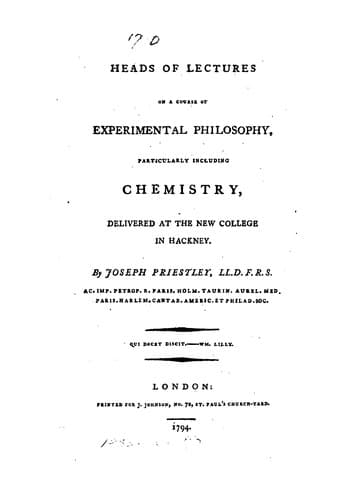
Heads of Lectures on a Course of Experimental Philosophy: Particularly Including ChemistryPriestley, Joseph
Philosophy
Heads of Lectures on a Course of Experimental Philosophy: Particularly Including Chemistry
Priestley, Joseph
Chemistry -- Early works to 1800
Also, as in old cities many buildings will fall to decay, while new ones
are added; you must expect to forget much of what you now know. No man
can give equal attention to every object; and as we advance in life,
we, in general, only learn new things at the expence of the old ones.
But then they are the more valuable articles of knowledge, the more
general and leading principles, which remain with us; while the more
useless ones, things to which we give less attention because we find
them to be of less use, disappear. Yet it is no uncommon thing for
ingenious students to despise old scholars who are not so ready in the
_minutiae_ of literature, though they may have forgotten more than those
youths ever knew, and may retain what they cannot acquire without
forgetting as much.
Another observation proper to lessen the conceit of literary men, is,
that genius is not confined to _them_, but is equally great, though not
equally conspicuous, in every other line of life, and especially in
manufactures and the arts. Here, however, discoveries equal, with
respect to _sagacity_, to those of Newton, contribute little to
posthumous fame, because the discoverers are not writers.
But the greatest branch of intellectual excellence with respect to
which every other is nothing, and which, from its nature, can never be
foundation of any self-conceit, is _virtue_, or right dispositions of
mind, leading to right conduct in life. Proper sentiments, and just
affections of mind, arise from just, and often comprehensive, views of
things, past, present, and to come. And if the real greatness of any
thought, or action, be estimated by the number of elements that
constitute it, and its remoteness from the dictates of sense and natural
appetite, a virtuous and pious man will appear to be a much more
dignified character, more proper to be viewed with admiration and
esteem, than the greatest scholar; discovering, in fact, greater
comprehension and force of mind. I mean, however, that virtue which is
the result of reflection, of discipline, and much voluntary exertion,
which, though operating with equal promptness and facility, is as much
superior to mere _innocence_, and what is commonly called _good nature_,
as motions secondarily automative are to those that are primarily so; a
comparison which you who have studied _Hartley's Theory of the Mind_
will see the force of.
Public-domain text, read in full here on John Shaqi.
Reviews
Reviews
No reviews yet
Be the first to share your thoughts on this work.
Join the Discussion
Join the discussion
Sign in to leave a comment or review.
Sign InorCreate an account