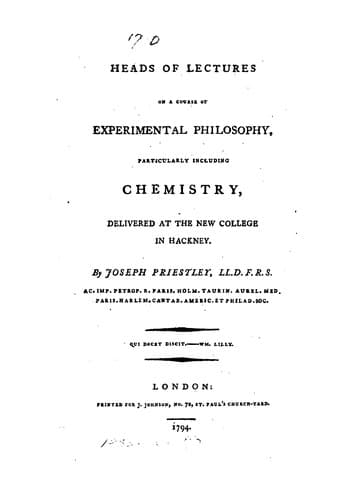
Heads of Lectures on a Course of Experimental Philosophy: Particularly Including ChemistryPriestley, Joseph
Philosophy
Heads of Lectures on a Course of Experimental Philosophy: Particularly Including Chemistry
Priestley, Joseph
Chemistry -- Early works to 1800
These differently-coloured rays of light are also separated in passing
through the transparent medium of air and water, in consequence of which
the sky appears blue and the sea green, these rays being returned, while
the red ones proceed to a greater distance. By this means also objects
at the bottom of the sea appear to divers red, and so do all objects
enlightened by an evening sun.
The mixture of all the differently-coloured rays, in the proportions in
which they cover the coloured image above mentioned, makes a _white_,
and the absence of all light is _blackness_.
By means of the different refrangibility of light, the colours of the
rainbow may be explained.
The distance to which the differently-coloured rays are separated from
each other is not in proportion to the mean refractive power of the
medium, but depends upon the peculiar constitution of the substance by
which they are refracted. The _dispersing power_ of glass, into the
composition of which _lead_ enters, is great in proportion to the mean
refraction; and it is proportionally little in that glass in which there
is much alkaline salt. The construction of _achromatic telescopes_
depends upon this principle.
Not only have different rays of light these different properties with
respect to bodies, so as to be more or less refracted, or dispersed, by
them, but different sides of the same rays seem to have different
properties, for they are differently affected on entering a piece of
_island crystal_. With the same degree of incidence; part of the pencil
of rays, consisting of all the colours, proceeds in one direction, and
the rest in a different one; so that objects seen through a piece of
this substance appear double.
At the surface of all bodies rays of light are promiscuously reflected,
or transmitted.
But if the next surface be very near to it, the rays of one colour
chiefly are reflected, and the rest transmitted, and these places occur
alternately for rays of each of the colours in passing from the thinnest
to the thickest parts of the medium; so that several series, or orders,
of colours will be visible on the surface of the same thin transparent
body. On this principle coloured rings appear between a plane and a
convex lens, in a little oil on the surface of water, and in bubbles
made with soap and water.
When rays of light pass near to any body, so as to come within the
sphere of its attraction and repulsion, an _inflection_ takes place; all
the kinds of rays being bent _towards_, or _from_, the body, and these
powers affecting some rays more than others, they are by this means also
separated from each other, so that coloured streaks appear both within
the shadow, and the outside of it, the red rays being inflected at the
greatest distance from the body.
Public-domain text, read in full here on John Shaqi.
Reviews
Reviews
No reviews yet
Be the first to share your thoughts on this work.
Elsewhere in the archive
Join the Discussion
Join the discussion
Sign in to leave a comment or review.
Sign InorCreate an account