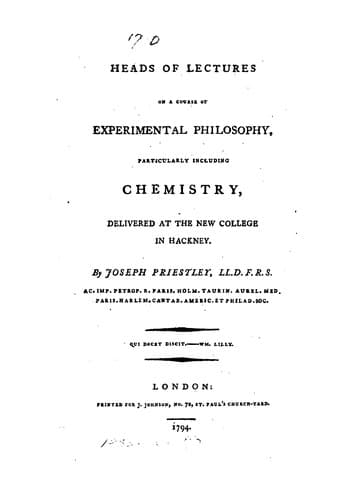
Heads of Lectures on a Course of Experimental Philosophy: Particularly Including ChemistryPriestley, Joseph
Philosophy
Heads of Lectures on a Course of Experimental Philosophy: Particularly Including Chemistry
Priestley, Joseph
Chemistry -- Early works to 1800
Part of the light which enters bodies is retained within them, and
proceeds no farther; but so loosely in some kinds of bodies, that a
small degree of heat is sufficient to expel it again, so as to make the
body visible in the dark: but the more heat is applied, the sooner is
all the light expelled. This is a strong argument for the materiality of
light. _Bolognian phosphorus_ is a substance which has this property;
but a composition made by Mr. Canton, of calcined oyster-shells and
sulphur, in a much greater degree. However, white paper, and most
substances, except the metals, are possessed of this property in a small
degree.
Some bodies, especially phosphorus, and animal substances tending to
putrefaction, emit light without being sensibly hot.
The _colours_ of vegetables, and likewise their _taste_ and _smell_,
depend upon light. It is also by means of light falling on the leaves
and other green parts of plants, that they emit dephlogisticated air,
which preserves the atmosphere fit for respiration.
It is light that imparts colour to the skins of men, by means of the
fluid immediately under them. This is the cause of _tanning_, of the
_copper colour_ of the North Americans, and the _black_ of the Negroes.
Light also gives colour to several other substances, especially the
solutions of mercury in acids.
LECTURE XXXIII.
_Of Magnetism._
Magnetism is a property peculiar to iron, or some ores of it. The earth
itself, owing probably to the iron ores contained in it, has the same
property. But though all iron is acted upon by magnetism, _steel_ only
is capable of having the power communicated to it.
Every magnet has two poles, denominated _north_ and _south_, each of
which attracts the other, and repels that of the same kind with itself.
If a magnet be cut into two parts, between the two poles, it will make
two magnets, the parts that were contiguous becoming opposite poles.
Though the poles of a magnet are denominated _north_ and _south_, they
do not constantly, and in all parts of the earth, point due north or
south, but in most places to the east or west of them, and with a
considerable variation in a course of time. Also a magnet exactly
balanced at its center will have a declination from an horizontal
position of about 70 degrees. The former is called the _variation_, and
the latter the _dipping_ of the magnetic needle.
Public-domain text, read in full here on John Shaqi.
Reviews
Reviews
No reviews yet
Be the first to share your thoughts on this work.
Elsewhere in the archive
Join the Discussion
Join the discussion
Sign in to leave a comment or review.
Sign InorCreate an account