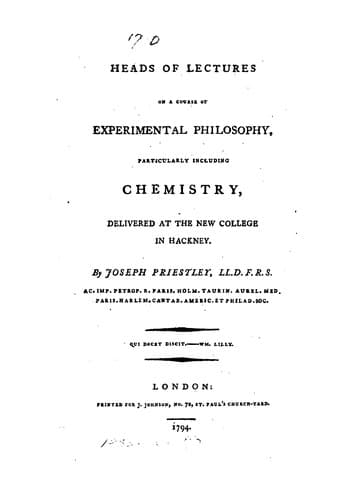
Heads of Lectures on a Course of Experimental Philosophy: Particularly Including ChemistryPriestley, Joseph
Philosophy
Heads of Lectures on a Course of Experimental Philosophy: Particularly Including Chemistry
Priestley, Joseph
Chemistry -- Early works to 1800
A straight bar of iron which has been long fixed in a vertical position,
will become a magnet, the lower end becoming a north pole, and the upper
end a south one; for if it be suspended horizontally, the lower end will
point towards the north, and the upper end towards the south. Also any
bar of iron, not magnetical, held in a vertical position, will become a
temporary magnet, the lower end becoming a north pole, and the upper end
a south one; and a few strokes of a hammer will fix the poles for a
short time, though the position of the ends be changed. Magnetism may
likewise be given to a bar of iron by placing it firmly in the position
of the dipping-needle, and rubbing it hard one way with a polished steel
instrument. Iron will also become magnetical by ignition and quenching
it in water in the position of the dipping-needle.
Magnetism acts, without any diminution of its force, through any medium;
and iron not magnetical will have that power while it is in connexion
with a magnet, or rather the power of the magnet is extended through the
iron.
Steel filings gently thrown upon a magnet, adhere to it in a curious
manner; and the filings, acquiring magnetism by the contact, adhere
together, and form a number of small magnets, which arrange themselves
according to the attraction of the poles of the original magnet. This
experiment is made to the most advantage upon a piece of pasteboard, or
paper, placed over the magnet.
Magnetism is communicated by the friction, or the near position, of a
magnet to a piece of steel of a size less than it. For this reason a
combination of magnetical bars will have a greater effect than a single
one; and in the following manner, beginning without any magnetism at
all, the greatest quantity may be procured. Six bars of steel may be
rendered slightly magnetical by fixing each of them successively to an
upright poker, and stroking it several times from the bottom to the top
with the lower end of an old pair of tongs. If then four of these bars
be joined, the magnetism of the remaining two will be much increased by
a proper method of rubbing with them; and by changing their places,
joining the strongest, and acting upon the weakest, they may all be made
as magnetical as they are capable of being.
The strength of a natural magnet may be increased by covering its polar
extremities with steel. This is called the _arming_ of the loadstone.
Public-domain text, read in full here on John Shaqi.
Reviews
Reviews
No reviews yet
Be the first to share your thoughts on this work.
Elsewhere in the archive
Join the Discussion
Join the discussion
Sign in to leave a comment or review.
Sign InorCreate an account