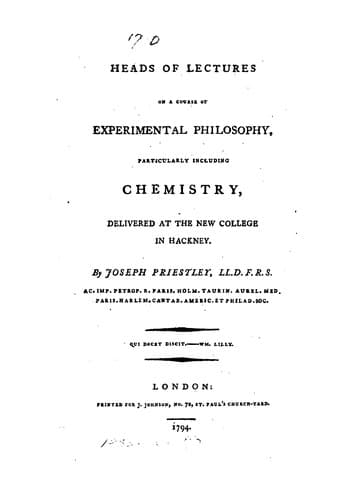
Heads of Lectures on a Course of Experimental Philosophy: Particularly Including ChemistryPriestley, Joseph
Philosophy
Heads of Lectures on a Course of Experimental Philosophy: Particularly Including Chemistry
Priestley, Joseph
Chemistry -- Early works to 1800
To account for the variation of the needle, Dr. Halley supposed the
earth to consist of two parts, an external _shell_ and an internal
_nucleus_, detached, and having a revolution distinct from it; and that
the action of the poles of the shell and of the nucleus would explain
all the varieties in the position of the needle. But others think that
the cause of the magnetism of the earth is not _within_, but _without_
itself. One reason for this opinion is, that a magnet is liable to be
affected by a strong aurora borealis; and another is, that the variation
of the needle proceeds in such manner as supposes that the motion of the
nucleus must be quicker than that of the shell of the earth; whereas,
since it is most natural to suppose that motion was communicated to the
nucleus by the shell, it would be slower.
Some idea of the quantity and the progress of the variation of the
needle may be formed from the following facts.--At the Cape of Good
Hope, when it was discovered by the Portuguese, in 1486, there was no
variation, the needle there pointing due north; in 1622 it was about 2
degrees westward, in 1675 it was 8 deg. W. in 1700 about 11 deg. W. in 1756
about 18 deg. W. and in 1774 about 21-1/2 deg. W. In London, in 1580, the variation
was 11 degrees 15 seconds E.; in 1622 it was 6 deg. E. in 1634 it was 4 deg.
5 min. E. in 1657 it was nothing at all; in 1672 it was 2 deg. 30 min.
W. in 1692 it was 6 deg. W. in 1753 it was about 16 W. and at present it
is about 21 W.
The longitude may in some places be found by the variation of the
needle; and Mr. Churchman, of America, having given much attention to
the subject, comparing the observations of others, and many of his own,
thinks that he has found a method of determining the longitude to a
great degree of certainty, in most cases, by this means.
He says there are two magnetic poles of the earth, one to the north and
the other to the south, at different distances from the poles of the
earth, and revolving in different times; and from the combined influence
of these two poles he deduces rules for the position of the needle in
all places of the earth, and at all times, past, present, or to come.
The north magnetic pole, he says, makes a complete revolution in 426
years, 77 days, 9 hours, and the south pole in about 5459 years. In the
beginning of the year 1777 the north magnetic pole was in 76 deg. 4 min.
north latitude; and in longitude from Greenwich 140 deg. east; and the
south was in 72 deg. south latitude, and 140 deg. east from Greenwich.
LECTURE XXXIV.
_Of Electricity._
Public-domain text, read in full here on John Shaqi.
Reviews
Reviews
No reviews yet
Be the first to share your thoughts on this work.
Elsewhere in the archive
Join the Discussion
Join the discussion
Sign in to leave a comment or review.
Sign InorCreate an account