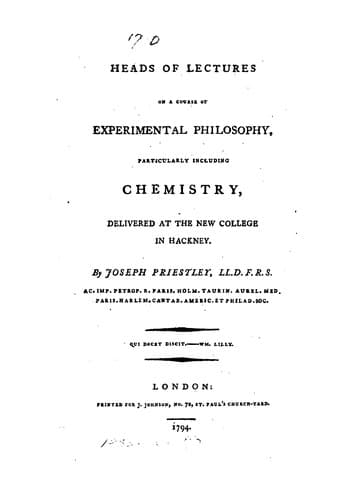
Heads of Lectures on a Course of Experimental Philosophy: Particularly Including ChemistryPriestley, Joseph
Philosophy
Heads of Lectures on a Course of Experimental Philosophy: Particularly Including Chemistry
Priestley, Joseph
Chemistry -- Early works to 1800
Electricity is a property belonging to, or capable of being communicated
to, all substances whatever; and whereas by some of them it is
transmitted with great ease, and by others with much difficulty, they
have been divided into two classes, and denominated _conductors_ or
_non-conductors_ of electricity. Also the latter receiving this power by
friction, and other means, are termed _electrics_, and the former
_non-electrics_.
Metals of all kinds, and water, are conductors, though in very different
degrees; so also is charcoal. All other substances, and also a perfect
vacuum, are non-conductors of electricity. But many of these substances,
when they are made very hot, as glass, resin, baked wood, and perhaps
all the rest on which the experiment can be made in this state, are
conductors.
It is the property of all kinds of electrics, when they are rubbed by
bodies different from themselves, to attract light substances of all
kinds, to exhibit an appearance of _light_, attended with a particular
_sound_, on the approach of any conductor; and if the nostrils are
presented, they are affected with a _smell_ like that of phosphorus.
This attraction is most easily explained by supposing that electricity
is produced by a fluid exceedingly elastic, or repulsive of itself, and
attracted by all other substances.
An electric exhibiting the appearances above mentioned, is said to be
_excited_, and some of them, particularly the _tourmaline_, are excited
by heating and cooling, as well as by friction. It appears, however,
that excitation consists in the mere transferring of electricity from
one substance to another, and that the great source of electricity is in
the earth. On this account it is necessary to the considerable
excitation of any electric, that the substance against which it is
rubbed (hence termed _the rubber_) have a communication with the earth,
by means of conductors; for if the rubber be _insulated_, that is cut
off from all communication with the earth by means of electrics, the
friction has but little effect.
When insulated bodies have been attracted by, and brought into contact
with, an excited electric, they begin to be repelled by it, and also to
repel one another; nor will they be attracted again till they have been
brought into contact with some conductor communicating with the earth;
but after this they will be attracted as at first.
If conductors be _insulated_, electric powers may be communicated to
them by the approach of excited electrics, or the contact of other
electrified bodies. They will then attract light bodies, and give
sparks, &c. like the excited electrics themselves.
Public-domain text, read in full here on John Shaqi.
Reviews
Reviews
No reviews yet
Be the first to share your thoughts on this work.
Elsewhere in the archive
Join the Discussion
Join the discussion
Sign in to leave a comment or review.
Sign InorCreate an account