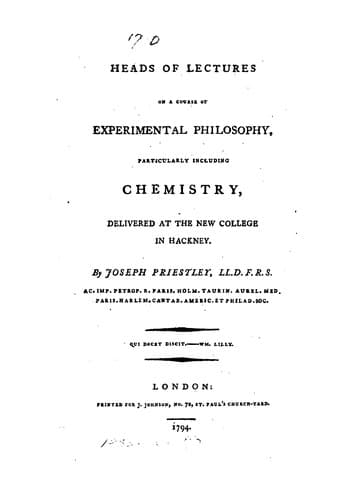
Heads of Lectures on a Course of Experimental Philosophy: Particularly Including ChemistryPriestley, Joseph
Philosophy
Heads of Lectures on a Course of Experimental Philosophy: Particularly Including Chemistry
Priestley, Joseph
Chemistry -- Early works to 1800
When electricity is strongly communicated to insulated animal bodies,
the pulse is quickened, and perspiration increased; and if they receive,
or part with, their electricity on a sudden, a painful sensation is felt
at the place of communication. But what is more extraordinary, is, that
the influence of the brain and nerves upon the muscles seems to be of an
electric nature.
This is one of the last and most important of all philosophical
discoveries. I shall, therefore, give the result of all the observations
that have hitherto been made on the subject, in a _series of
propositions_, drawn up by an intelligent friend, who has given much
more attention to it than I have done.
1. The nerve of the limb of an animal being laid bare, and surrounded
with a piece of sheet lead, or of tinfoil, if a communication be formed
between the nerve thus armed and any of the neighbouring muscles, by
means of a piece of zinc, strong contractions will be produced in the
limb.
2. If a portion of the nerve which has been laid bare be armed as above,
contractions will be produced as powerfully, by forming the
communication between the armed and bare part of the nerve, as between
the armed part and muscle.
3. A similar effect is produced by arming a nerve and simply touching
the armed part of the nerve with the metallic conductor.
4. Contractions will take place if a muscle be armed, and a
communication be formed by means of the conductor between it and a
neighbouring nerve. The same effect will be produced if the
communication be formed between the armed muscle and another muscle,
which is contiguous to it.
5. Contractions may be produced in the limb of an animal by bringing the
pieces of metal into contact with each other at some distance from the
limb, provided the latter make part of a line of communication between
the two metallic conductors.
The experiment which proves this is made in the following manner. The
amputated limb of an animal being placed upon a table, let the operator
hold with one hand the principal nerve, previously laid bare, and in the
other let him hold a piece of zinc; let a small plate of lead or silver
be then laid upon the table, at some distance from the limb, and a
communication be formed, by means of water, between the limb and the
part of the table where the metal is lying. If the operator touch the
piece of silver with the zinc, contractions will be produced in the limb
the moment that the metals come into contact with each other. The same
effect will be produced if the two pieces of metal be previously placed
in contact, and the operator touch one of them with his finger. This
fact was discovered by Mr. William Cruikshank.
6. Contractions can be produced in the amputated leg of a frog, by
putting it into water, and bringing the two metals into contact with
each other at a small distance from the limb.
Public-domain text, read in full here on John Shaqi.
Reviews
Reviews
No reviews yet
Be the first to share your thoughts on this work.
Elsewhere in the archive
Join the Discussion
Join the discussion
Sign in to leave a comment or review.
Sign InorCreate an account