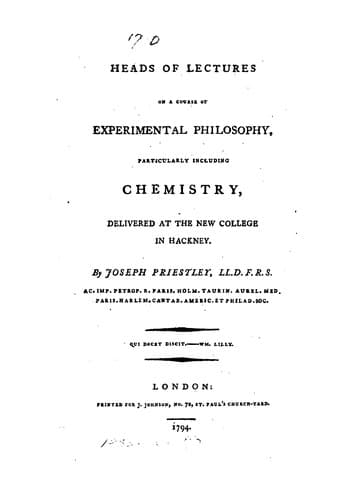
Heads of Lectures on a Course of Experimental Philosophy: Particularly Including ChemistryPriestley, Joseph
Philosophy
Heads of Lectures on a Course of Experimental Philosophy: Particularly Including Chemistry
Priestley, Joseph
Chemistry -- Early works to 1800
7. The influence which has passed through, and excited contractions in,
one limb, may be made to pass through, and excite contractions in,
another limb. In performing this experiment it is necessary to attend to
the following circumstances: let two amputated limbs of a frog be taken;
let one of them be laid upon a table, and its foot be folded in a piece
of silver; let a person lift up the nerve of this limb with a silver
probe, and another person hold in his hand a piece of zinc, with which
he is to touch the silver including the foot; let the person holding the
zinc in one hand catch with the other the nerve of the second limb, and
he who touches the nerve of the first limb is to hold in his other hand
the foot of the second; let the zinc now be applied to the silver
including the foot of the first limb, and contractions will immediately
be excited in both limbs.
8. The heart is the only involuntary muscle in which contractions can be
excited by these experiments.
9. Contractions are produced more strongly, the farther the coating is
placed from the origin of the nerve.
10. Animals which were almost dead have been found to be considerably
revived by exciting this influence.
11. When these experiments are repeated upon an animal that has been
killed by opium, or by the electric shock, very slight contractions are
produced; and no contractions whatever will take place in an animal that
has been killed by corrosive sublimate, or that has been starved to
death.
12. Zinc appears to be the best exciter when applied to gold, silver,
molybdena, steel, or copper. The latter metals, however, excite but
feeble contractions when applied to each other. Next to zinc, in contact
with these metals, tin and lead, and silver and lead, appear to be the
most powerful exciters.
At least two kinds of fishes, the _torpedo_ and the _electrical eel_,
have a voluntary power of giving so strong a shock to the water in which
they swim, as to affect fishes and other animals which come near them;
and by a conducing communication between different parts of these
fishes, an electric shock may be given exactly like that of the Leyden
phial, which will be described hereafter; and if the communication be
interrupted, a flash of electric light will be perceived.
The growth of vegetables is also quickened by electricity.
LECTURE XXXV.
_The same Subject continued._
No electric can be excited without producing electric appearances in the
body with which it is excited, provided that body be insulated; for this
insulated rubber will attract light bodies, give sparks, and make a
snapping noise, upon the approach of a conductor, as well as the excited
electric.
If an insulated conductor be pointed, or if a pointed conductor,
communicating with the earth, be held pretty near it, little or no
electric appearance will be exhibited, only a light will appear at each
of the points during the act of excitation, and a current of air will be
sensible from off them both.
Public-domain text, read in full here on John Shaqi.
Reviews
Reviews
No reviews yet
Be the first to share your thoughts on this work.
Elsewhere in the archive
Join the Discussion
Join the discussion
Sign in to leave a comment or review.
Sign InorCreate an account