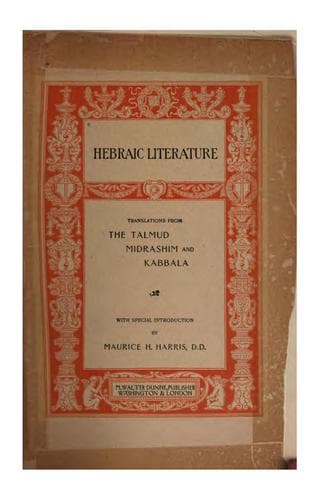
Hebraic Literature; Translations from the Talmud, Midrashim and Kabbala
Religion
Hebraic Literature; Translations from the Talmud, Midrashim and Kabbala
Hebrew literature -- Translations into English
"He caused the lame to mount on the back of the blind, and judged them
both as one." Antoninus said to the Rabbi, "Body and soul might each
plead right of acquittal at the day of judgment." "How so?" he asked.
"The body might plead that it was the soul that had sinned, and urge,
saying, 'See, since the departure of the soul I have lain in the grave
as still as a stone.' And the soul might plead, 'It was the body that
sinned, for since the day I left it, I have flitted about in the air as
innocent as a bird.'" To which the Rabbi replied and said, "Whereunto
this thing is like, I will tell thee in a parable. It is like unto a
king who had an orchard with some fine young fig trees planted in it. He
set two gardeners to take care of them, of whom one was lame and the
other blind. One day the lame one said to the blind 'I see some fine
figs in the garden; come, take me on thy shoulders, and we will pluck
them and eat them.' By and by the lord of the garden came, and missing
the fruit from the fig trees, began to make inquiry after them. The lame
one, to excuse himself, pleaded, 'I have no legs to walk with;' and the
blind one, to excuse himself, pleaded, 'I have no eyes to see with.'
What did the lord of the garden do? He caused the lame to mount upon the
back of the blind, and judged them both as one." So likewise will God
re-unite soul and body, and judge them both as one together; as it is
written (Ps. 1, 4), "He shall call to the heavens from above, and to the
earth, that He may judge His people." "He shall call to the heavens from
above," that alludes to the soul; "and to the earth, that He may judge
His people," that refers to the body.
_Sanhedrin_, fol. 91, cols, 1, 2.
Rabbi Yehudah, surnamed the Holy, the editor of the Mishnah, is
the personage here and elsewhere spoken of as the Rabbi by pre
eminence. He was an intimate friend of the Roman Emperor
Antoninus Pius.
One thing obtained with difficulty is far better than a hundred things
procured with ease.
_Avoth d'Rab. Nathan_, ch. 3.
In the name of Rav, Rabbi Yehoshua bar Abba says, "Whoso buys a scroll
of the law in the market seizes possession of another's meritorious act;
but if he himself copies out a scroll of the law, Scripture considers
him as if he had himself received it direct from Mount Sinai." "Nay,"
adds Rav Yehudah, in the name of Rav, "even if he has amended one letter
in it, Scripture considers him as if he had written it out entirely."
_Menachoth_, fol. 30, col. 1.
He who forgets one thing that he has learned breaks a negative
commandment; for it is written (Deut. iv. 9), "Take heed to thyself ...
lest thou forget the things."
_Menachoth_, fol. 99, col. 2.
A proselyte who has taken it upon himself to observe the law, but is
suspected of neglecting one point, is to be suspected of being guilty of
neglecting the whole law, and therefore regarded as an apostate
Israelite, and to be punished accordingly.
_Bechoroth_, fol. 30, col. 2.
Public-domain text, read in full here on John Shaqi.
Reviews
Reviews
No reviews yet
Be the first to share your thoughts on this work.
Join the Discussion
Join the discussion
Sign in to leave a comment or review.
Sign InorCreate an account