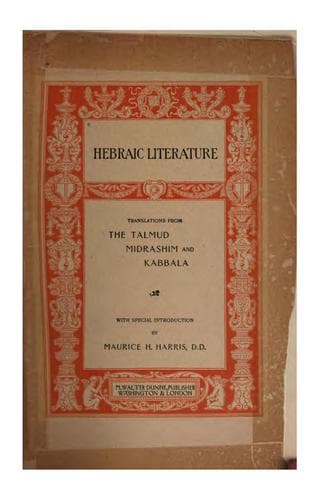
Hebraic Literature; Translations from the Talmud, Midrashim and Kabbala
Religion
Hebraic Literature; Translations from the Talmud, Midrashim and Kabbala
Hebrew literature -- Translations into English
It is written (Gen. xxviii. ii), "And he took from the stones of the
place;" and again it is written (ver. 18), "And he took the stone."
Rabbi Isaac says this teaches that all these stones gathered themselves
together into one place, as if each were eager that the saint should lay
his head upon it. It happened, as the Rabbis tell us, that all the
stones were swallowed up by one another, and thus merged into one stone.
_Chullin_, fol. 91, col. 2.
Though the Midrash and two of the Targums, that of Jonathan and
the Yerushalmi, tell the same fanciful story about these stones,
Aben Ezra and R. Shemuel ben Meir among others adopt the
opposite and common-sense interpretation which assigns to the
word in Gen. xxviii. ii, no such occult meaning.
The psalms commencing "Blessed is the man" and "Why do the heathen rage"
constitute but one psalm.
_Berachoth_ fol. 9, col. 2.
The former Chasidim used to sit still one hour, and then pray for one
hour, and then again sit still for one hour.
Ibid., fol. 32, col. 2.
All the benedictions in the Temple used to conclude with the words
"Blessed be the Lord God of Israel unto eternity;" but when the
Sadducees, corrupting the faith, maintained that there was only one
world, it was enacted that they should conclude with the words "from
eternity unto eternity."
_Berachoth_, fol. 54, col. i.
The Sadducees (Zadokim), so called after Zadok their master, as
is known, stood rigidly by the original Mosaic code, and set
themselves determinedly against all traditional developments. To
the Talmudists, therefore, they were especially obnoxious, and
their bald, cold creed is looked upon by them with something
like horror. It is thus the Talmud warns against them--"Believe
not in thyself till the day of thy death, for, behold, Yochanan,
after officiating in the High Priesthood for eighty years,
became in the end a Sadducee." (_Berachoth_, fol. 29, col. 1.)
In Derech Eretz Zuta, chap. i., a caution is given which might
well provoke attention--"Learn or inquire nothing of the
Sadducees, lest thou be drawn into hell."
Rabbi Yehudah tells us that Rav says a man should never absent himself
from the lecture hall, not even for one hour; for the above Mishnah had
been taught at college for many years, but the reason of it had never
been made plain till the hour when Rabbi Chanina ben Akavia came and
explained it.
_Shabbath_, fol. 83, col. 2.
The Mishnah alluded to is short and simple, viz, Where is it
taught that a ship is clean to the touch? From Prov. xxx. 19,
"The way of a ship in the midst of the sea." (i.e., as the sea
is clean to the touch, therefore a ship must also be clean to
the touch).
It is indiscreet for one to sleep in a house as the sole occupant, for
Lilith will seize hold of him.
Ibid., fol. 151, col. 2.
Public-domain text, read in full here on John Shaqi.
Reviews
Reviews
No reviews yet
Be the first to share your thoughts on this work.
Join the Discussion
Join the discussion
Sign in to leave a comment or review.
Sign InorCreate an account