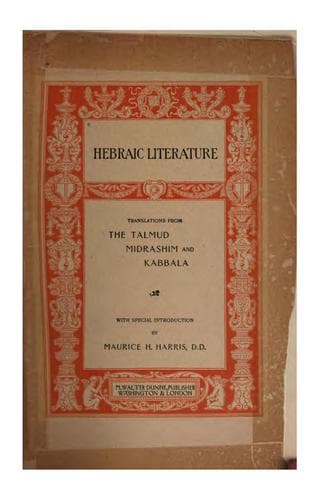
Hebraic Literature; Translations from the Talmud, Midrashim and Kabbala
Religion
Hebraic Literature; Translations from the Talmud, Midrashim and Kabbala
Hebrew literature -- Translations into English
"And Haman told them of the glory of his riches and the multitude of his
children" (Esth. v. 11). And how many children were there? Rav said
thirty; ten had died, ten were hanged, and ten went about begging from
door to door. The Rabbis say, "Those that went about begging from door
to door were seventy; for it is written (1 Sam. ii. 5), 'They that were
full have hired themselves for bread.'"
_Meggillah_, fol. 15, col. 2.
When Rabbi Chanena bar Pappa was about to die, the Angel of Death was
told to go and render him some friendly service. He accordingly went and
made himself known to him. The Rabbi requested him to leave him for
thirty days, until he had repeated what he had been learning; for it is
said, "Blessed is he who comes here with his studies in his hand." He
accordingly left, and at the expiration of thirty days returned to him.
The Rabbi then asked to be shown his place in Paradise, and the Angel of
Death consented to show him while life was still in him. Then said the
Rabbi, "Lend me thy sword, lest thou surprise me on the road and cheat
me of my expectation." To this the Angel of Death said, "Dost thou mean
to serve me as thy friend Rabbi Yoshua did?" and he declined to intrust
the sword to the Rabbi.
_Kethuboth_, fol. 77, col. 2.
If a man says to a woman, "Thou art betrothed to me after thirty days,"
and in the interim another comes and betroths her, she is the second
suitor's.
_Kiddushin_, fol. 58, col 2.
If one finds a scroll, he may peruse it once in thirty days, but he must
not teach out of it, nor may another join him in reading it; if he does
not know how to read, he must unroll it. If a garment be found, it
should be shaken and spread out once in thirty days, for its own sake
(to preserve it), but not for display. Silver and copper articles should
be used to take care of them, but not for the sake of ornament. Gold and
glass vessels he should not meddle with--till the coming of Elijah.
_Bava Metzia_, fol. 29, col. 2.
Rabbi Zira so inured his body (to endurance) that the fire of Gehenna
had no power over it. Every thirty days he experimented on himself,
ascending a fiery furnace, and finally sitting down in the midst of it
without being affected by the fire. One day, however, as the Rabbis
fixed their eyes upon him, his hips became singed, and from that day
onward he was noted in Jewry as the little man with the singed hips.
Ibid., fol. 85, col. 1.
Public-domain text, read in full here on John Shaqi.
Reviews
Reviews
No reviews yet
Be the first to share your thoughts on this work.
Elsewhere in the archive
Join the Discussion
Join the discussion
Sign in to leave a comment or review.
Sign InorCreate an account