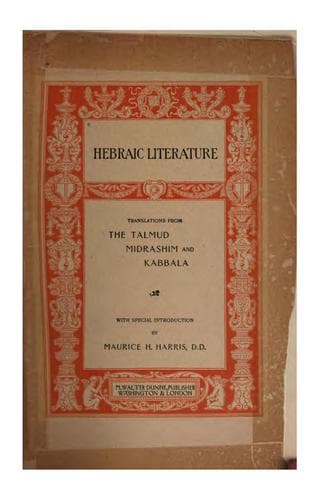
Hebraic Literature; Translations from the Talmud, Midrashim and Kabbala — John Shaqi
Hebraic Literature; Translations from the Talmud, Midrashim and Kabbala
Religion
Hebraic Literature; Translations from the Talmud, Midrashim and Kabbala
Hebrew literature -- Translations into English
Abba Benjamin felt anxious to have children, for "any man not
having children is counted as dead," as it is written (Gen. xxx.
1), "Give me children, or else I die." (_Nedarin_, fol. 64, col.
2.)
With the Jew one great consideration of life is to have
children, and more especially male children; because when a boy
is born all rejoice over him, but over a girl they all mourn.
When a boy comes into the world he brings peace with him, and a
loaf of bread in his hand, but a girl brings nothing. (_Niddah_,
fol. 31, col. 2.)
It is impossible for the world to be without males and females,
but blessed is he whose children are boys, and hapless is he
whose children are girls. (_Kiddushin_, fol. 82, col. 2.)
Whosoever does not leave a son to be heir, God will heap wrath
upon him. (Scripture is quoted in proof of this, compare Numb.
xxvii. 8 with Zeph. i. 15.) (_Bava Bathra_, fol. 116, col. 1.)
"There are two ways before me, one leading into Paradise, the other into
Hell." When Yochanan, the son of Zachai, was sick unto death, his
disciples came to visit him; and when he saw them he wept, upon which
his disciples exclaimed, "Light of Israel! Pillar of the right! Mighty
Hammer! why weepest thou?" He replied, "If I were going to be led into
the presence of a king, who is but flesh and blood, to-day here and
to-morrow in the grave, whose anger with me could not last forever,
whose sentence against me, were it even unto death, could not endure
forever, and whom perhaps I might pacify with words or bribe with money,
yet for all that should I weep; but now that I am about to enter the
presence of the King of kings, the Holy One--blessed be He forever and
ever!--whose anger would be everlasting, whose sentence of death or
imprisonment admits of no reprieve, and who is not to be pacified with
words nor bribed with money, and in whose presence there are two roads
before me, one leading into Paradise and the other into Hell, and should
I not weep?" Then prayed they him, and said, "Rabbi, give us thy
farewell blessing;" and he said unto them, "Oh that the fear of God may
be as much upon you as the fear of man."
_Berachoth_, fol. 28, col. 2.
Rabbi Ami says, "Knowledge is of great price, for it is placed between
two divine names, as it is written (I Sam. ii. 3), 'A God of knowledge
is the Lord,' and therefore mercy is to be denied to him who has no
knowledge; for it is written (Isa. xxvii. 11), 'It is a people of no
understanding, therefore He that hath made them will not have mercy on
them.'"
_Berachoth_ fol. 33, col. 1.
Here we have a clear law, drawn from Scripture, forbidding, or
at any rate denying, mercy to the ignorant. The words of Rabbi
(the Holy) are a practical commentary on the text worth quoting,
"Woe is unto me because I have given my morsel to an ignorant
one." (_Bava Bathra_, fol. 8, col. 1.)
Public-domain text, read in full here on John Shaqi.
Reviews
Reviews
No reviews yet
Be the first to share your thoughts on this work.
Join the Discussion
Join the discussion
Sign in to leave a comment or review.
Sign InorCreate an account