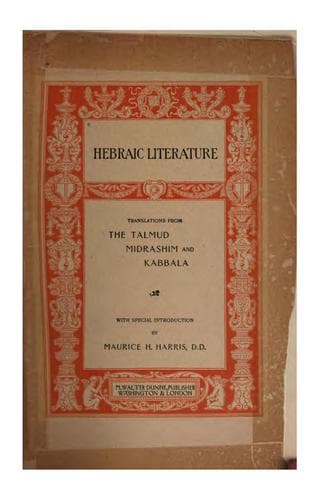
Hebraic Literature; Translations from the Talmud, Midrashim and Kabbala
Religion
Hebraic Literature; Translations from the Talmud, Midrashim and Kabbala
Hebrew literature -- Translations into English
But who is the ignorant one from whom this mercy is to be
withheld? Here the doctors disagree. He, says Rabbi Eliezer, who
does not read the Shema, "Hear, O Israel," etc., both morning
and evening. According to Rabbi Yehudah, he that does not put on
phylacteries is an ignorant one. Rabbi Azai affirms that he who
wears no fringes to his garment is an ignorant one, etc. Others
again say he who even reads the Bible and the Mishna but does
not serve the disciples of the wise, is an ignorant one. Rabbi
Huna winds up with the words "the law is as the others have
said," and so leaves the difficulty where he finds it.
(_Berachoth_, fol. 47, col. 2.)
Of him "who transgresses the words of the wise, which he is
commanded to obey," it is written, "He is guilty of death and
has forfeited his life." (_Berachoth_, fol. 4, col. 2, and
_Yevamoth_, fol. 20, col. 1.) Whoso, therefore, shows mercy to
him contradicts the purpose and incurs the displeasure of God.
It was in application of this principle, literally interpreted,
that the wise should hold no parley with the ignorant, which led
the Jews to condemn the contrary procedure of Jesus Christ.
It was this prohibition to show mercy to the ignorant, together
with the solemn threatenings directed against those who
neglected the study of the law, that worked such a wonderful
revolution in Hezekiah's time; for it is said that then "they
searched from Dan to Beersheba, and did not find an ignorant
one." (_Sanhedrin_, fol. 94, col. 2.)
When the Holy One--blessed be He!--remembers that His children are in
trouble among the nations of the world, He drops two tears into the
great ocean, the noise of which startles the world from one end to the
other, and causes the earth to quake.
_Berachoth_, fol. 59, col. 1.
We read in the Talmud that a Gentile once came to Shamai and said, "How
many laws have you?" Shamai replied, "We have two, the written law and
the oral law." To which the Gentile made answer, "When you speak of the
written law, I believe you, but in your oral law I have no faith.
Nevertheless, you may make me a proselyte on condition that you teach me
the written law only." Upon this Shamai rated him sharply, and sent him
away with indignant abuse. When, however, this Gentile came with the
same object, and proposed the same terms to Hillel, the latter proceeded
at once to proselytize him, and on the first day taught him Aleph, Beth,
Gemel, Daleth. On the morrow Hillel reversed the order of these letters,
upon which the proselyte remonstrated and said, "But thou didst not
teach me so yesterday." "True," said Hillel, "but thou didst trust me in
what I taught thee then; why, then, dost thou not trust me now in what I
tell thee respecting the oral law?"
_Shabbath_, fol. 31, col. 1.
Public-domain text, read in full here on John Shaqi.
Reviews
Reviews
No reviews yet
Be the first to share your thoughts on this work.
Join the Discussion
Join the discussion
Sign in to leave a comment or review.
Sign InorCreate an account