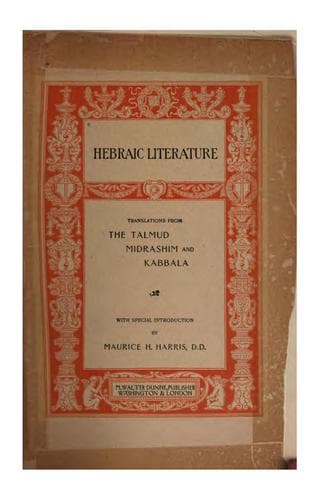
Hebraic Literature; Translations from the Talmud, Midrashim and Kabbala
Religion
Hebraic Literature; Translations from the Talmud, Midrashim and Kabbala
Hebrew literature -- Translations into English
"And Joseph took an oath of the children of Israel, ... ye shall carry
up my bones from hence" (Gen. l. 25). Rabbi Chanena said, "There is a
reason for this oath. As Joseph knew that he was perfectly righteous,
why then, if the dead are to rise in other countries as well as in the
land of Israel, did he trouble his brethren to carry his bones four
hundred miles?" The reply is, "He feared lest, if buried in Egypt, he
might have to worm his way through subterranean passages from his grave
into the land of Israel."
Ibid., fol. 111, col. 1.
To this day among the Polish Jews the dead are provided for
their long subterranean journey with little wooden forks, with
which, at the sound of the great trumpet, they are to dig and
burrow their way from where they happen to be buried till they
arrive in Palestine. To avoid this inconvenience there are some
among them who, on the approach of old age, migrate to the Holy
Land, that their bones may rest there against the morning of the
resurrection.
Rav Cahana was once selling ladies' baskets when he was exposed to the
trial of a sinful temptation. He pleaded with his tempter to let him off
and he promised to return, but instead of doing so he went up to the
roof of the house and threw himself down headlong. Before he reached the
ground, however, Elijah came and caught him, and reproached him, as he
caught him up, with having brought him a distance of four hundred miles
to save him from an act of willful self-destruction. The Rabbi told him
that it was his poverty which had given to the temptation the power of
seduction. Thereupon Elijah gave him a vessel full of gold denarii and
departed.
_Kiddushin_, fol. 40, col. 1.
"Pashur, the son of Immer the priest" (Jer. xx. 1) had four hundred
servants, and every one of them rose to the rank of the priesthood. One
consequence was that an insolent priest hardly ever appeared in Israel
but his genealogy could be traced to this base-born, low-bred ancestry.
Rabbi Elazar said, "If thou seest an impudent priest, do not think evil
of him, for it is said (Hos, iv. 4), 'Thy people are as they that strive
with the priest.'"
Ibid., fol. 70, col. 2.
David had four hundred young men, handsome in appearance and with their
hair cut close upon their foreheads, but with long flowing curls behind,
who used to ride in chariots of gold at the head of the army. These were
men of power (men of the fist, in the original), the mighty men of the
house of David, who went about to strike terror into the world.
_Kiddushin_, fol. 76, col. 2.
Public-domain text, read in full here on John Shaqi.
Reviews
Reviews
No reviews yet
Be the first to share your thoughts on this work.
Elsewhere in the archive
Join the Discussion
Join the discussion
Sign in to leave a comment or review.
Sign InorCreate an account