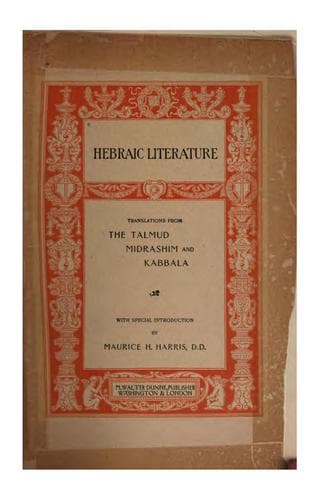
Hebraic Literature; Translations from the Talmud, Midrashim and Kabbala
Religion
Hebraic Literature; Translations from the Talmud, Midrashim and Kabbala
Hebrew literature -- Translations into English
"Every man ... by his own standard" (Num. ii. 2). The several princes of
Israel selected the colors for their banners from the color of the
stones that were upon the breastplate of Aaron. From them other princes
have learned to adorn their standards with different distinguishing
colors. Reuben had his flag red, and leaves of mandrakes upon it.
Issachar had his flag blue, and the sun and moon upon it. Naphtali had
on his flag an olive tree, for this reason that (Gen. xlix. 20) "Out of
Asher his bread shall be fat."
Ibid., chap. 7.
"And Abraham rose up early and saddled his ass" (Gen. xxii. 3). This is
the ass on which Moses also rode when he came into Egypt; for it is said
(Exod. iv. 20), "And Moses took his wife and his sons, and set them upon
an ass." This is the ass on which the Son of David also shall ride; as
it is said (Zech, ix. 9), "Poor, and riding upon an ass."
_Pirke d'Rab. Eliezer_, chap. 31.
In the morning service for Yom Kippur, there is an allusion to
the Scripture passage with which our quotation opens. It is said
that Abraham in "his great joy perverted the usual order," which
a footnote explains thus--"In the greatness of his joy, that he
had thus an opportunity of showing his obedience to God, he set
aside the usual order of things, which was that the servant
should saddle the ass, and saddled the ass himself, as mentioned
Gen. xxii. 3." The animal referred to in the above remarks is
spoken of in Sanhedrin, fol. 98, col. 1, as being of a hundred
colors.
When Joseph saw the signs of Judah's anger, he began to tremble, and
said (to himself), "Woe is me, for he may kill me!" And what were these
signs? Tears of blood rolling down from Judah's right eye, and the hair
that grew on his chest rising and penetrating through the five garments
that he wore. Joseph then kicked the marble seat on which he was
sitting, so that it was instantly shattered into fragments. Upon this
Judah observed, "He is a mighty man, like one of us."
_Yalkut Vayegash._
Abraham married three wives--Sarah, a daughter of Shem; Keturah, a
daughter of Japheth; and Hagar, a daughter of Ham.
_Yalkut, Job_, chap. 8.
Rashi supposes that Keturah was one and the same with Hagar--so
the Midrash, the Targum Yerushalmi, and that of Jonathan. The
latter says, "Keturah, she is Hagar, who had been bound to him
from the beginning," but Aben Ezra and most of the commentators
contend that Keturah and Hagar are two distinct persons, and the
use of the plural concubines, in verse 6, bears them out in this
assertion.
The Holy One--blessed be He!--daily proclaims a new law in the heavenly
court, and even all these were known to Abraham.
Ibid., chap. 37.
Public-domain text, read in full here on John Shaqi.
Reviews
Reviews
No reviews yet
Be the first to share your thoughts on this work.
Elsewhere in the archive
Join the Discussion
Join the discussion
Sign in to leave a comment or review.
Sign InorCreate an account