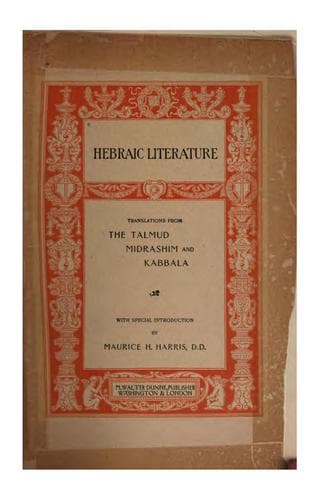
Hebraic Literature; Translations from the Talmud, Midrashim and Kabbala
Religion
Hebraic Literature; Translations from the Talmud, Midrashim and Kabbala
Hebrew literature -- Translations into English
In Ezek. v. 5 we read, "I have set Jerusalem in the midst of the
nations and countries that are round about her." On the literal
interpretation of these words it was asserted that Jerusalem was
the very centre of the world, or, as Jerome quaintly called it,
"the navel of the earth." In the Talmud we find a beautiful
metaphor in illustration of this view. It is in the last six
lines of the ninth chapter of Derech Eretz Zuta, which read
thus: "Issi ben Yochanan, in the name of Shemuel Hakaton, says,
'The world is like the eyeball of man; the white is the ocean
which surrounds the world, the black is the world itself, the
pupil is Jerusalem, and the image in the pupil is the Temple.
May it be built in our own days, and in the days of all Israel!
Amen!'" The memory of this conceit is kept alive to this day
among the Greek Christians, who still show the sacred stone in
the Church of the Holy Sepulchre at Jerusalem. This notion is
not confined to Jewry. Classic readers will at once call to mind
the appellation Omphalos or navel applied to the temple at
Delphi (Pindar, Pyth., iv. 131, vi. 3; Eurip. Ion., 461; Æsch.
Choeph., 1034; Eum. 40, 167; Strabo, etc.).
Two sparks issued from between the two cherubim and destroyed the
serpents and scorpions and burned the thorns in the wilderness. The
smoke thereof, rising and spreading, perfumed the world, so that the
nations said (Cant. iii. 6), "Who is this that cometh out of the
wilderness like pillars of smoke, perfumed," etc.
_Ibid., Vayakhel._
Better to lodge in the wilderness of the land of Israel than dwell in
the palaces outside of it.
_Midrash Rabbah_, chap. 39.
"And give thee a pleasant land" (a coveted land) (Jer. iii. 19). Why is
it called a coveted land? Because the Temple was in it. Another reason
why it was so called is, because the fathers of the world have coveted
it. Rabbi Shimon ben Levi says, "Because they (who are buried) there
will be the first to be raised in the days of the Messiah."
_Shemoth Rabbah_, chap. 32.
"When the Lord thy God shall enlarge thy border, as He hath promised
thee" (Deut. xii. 20). Rabbi Yitzchak said, "This scroll no man knows
how long and how broad it is, but when unrolled it speaks for itself,
and shows how large it is. It is so with the land of Israel, which, for
the most part, consists of hills and mountains; but when the Holy
One--blessed be He!--shall level it, as it is said (Isa. xl. 4), 'Every
valley shall be raised and every mountain and hill shall be made low,
and the crooked shall be made straight, and the rough places smooth,'
then shall that land speak, as it were, for herself, and its extent
stand revealed."
_Devarim Rabbah_, chap. 4.
Blessed are they who dwell in the land of Israel, for they have no sin,
no iniquity, either in their lives or in their deaths.
_Midrash Shochar Tov on Ps. lxxxv._
Public-domain text, read in full here on John Shaqi.
Reviews
Reviews
No reviews yet
Be the first to share your thoughts on this work.
Elsewhere in the archive
Join the Discussion
Join the discussion
Sign in to leave a comment or review.
Sign InorCreate an account