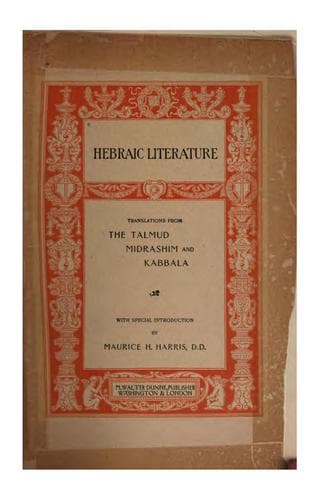
Hebraic Literature; Translations from the Talmud, Midrashim and Kabbala
Religion
Hebraic Literature; Translations from the Talmud, Midrashim and Kabbala
Hebrew literature -- Translations into English
Rabbi Yochanan and Rabbi Yonathan traveled one day together; they came
to two roads, one of which led by the door of a place devoted to the
worship of idols, and the other by a place of ill fame. Upon which one
said to the other, "Let us go by the former, because our inclination to
the evil that waylays us there is already extinguished." "Nay, rather,"
said the other, "let us go by the latter, and curb our desires; so shall
we receive a reward in recompense." In this resolution they went on, and
as they passed the place the women humbled themselves before them and
withdrew ashamed into their chambers. Then Yochanan asked the other,
"How didst thou know that this would occur to us?" He made answer, "From
what is written (in Prov. ii. 2), 'Discretion (in the law) shall
preserve thee.'"
_Avodah Zarah_, fol. 17, cols. 1, 2.
Given two dry firebrands and one piece of green wood, the dry will set
fire to the green.
_Sanhedrin_, fol 93, col. 1.
With two dogs they caught the lion.
Ibid., fol. 95, col. 1.
Both these proverbs express the same idea, that a minority, be
it ever so strong, must give way to a majority.
"And the elders of Moab and the elders of Midian departed together"
(Numb. xxii. 7). Midian and Moab were never friendly toward each other;
they were like two dogs tending a flock, always at variance. When the
wolf came upon the one, however, the other thought, "If I do not help my
neighbor to-day, the wolf may come upon myself to-morrow;" therefore the
two dogs leagued together and, killed the wolf. Hence, says Rabbi Pappa,
the popular saying, "The mouse and the cat are combined to make a feast
on the fat of the unfortunate."
Ibid., fol. 105, col. 1.
Rabbi Yochanan, in the name of Yossi, the son of Zimra, asks, "What is
this that is written (Ps. cxx. 3), 'What shall be given unto thee, or
what shall be added unto thee, O thou false tongue'?" The Holy
One--blessed be He!--said to the tongue, "All the members of the body
are erect, thou only art recumbent; all other members are without, thou
art within, and not only so, for I have surrounded thee with two walls,
one of bone and the other of flesh. What shall be given to thee, or what
shall be added unto thee, O thou false tongue?" Rabbi Yochanan, in the
name of Yossi, says, "He who slanders is an atheist, for it is written
(Ps. xii. 4), 'Who have said, With our tongues will we prevail; Our lips
are with us; who is lord over us?'"
_Erchin_, fol. 15, col. 2.
Here are a few sayings from the Talmud on the abuse of the
tongue.
He who slanders, he who receives slander, and he who bears false witness
against his neighbor, deserve to be cast to the dogs.
_Psachim_, fol. 118, col. 1.
All animals will one day remonstrate with the serpent and say, "The lion
treads upon his prey and devours it, the wolf tears and eats it, but
thou, what profit hast thou in biting?" The serpent will reply (Eccl.
viii. II), "I am no worse than a slanderer."
_Taanith_, fol. 8, col. 1.
Public-domain text, read in full here on John Shaqi.
Reviews
Reviews
No reviews yet
Be the first to share your thoughts on this work.
Join the Discussion
Join the discussion
Sign in to leave a comment or review.
Sign InorCreate an account