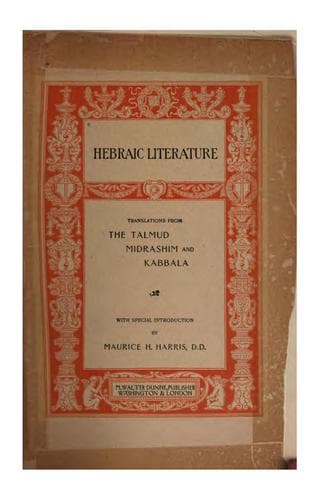
Hebraic Literature; Translations from the Talmud, Midrashim and Kabbala
Religion
Hebraic Literature; Translations from the Talmud, Midrashim and Kabbala
Hebrew literature -- Translations into English
"The man with two wives, one young and the other old." Rav Ami and Rav
Assi were in social converse with Rabbi Isaac Naphcha, when one of them
said to him, "Tell us, sir, some pretty legend," and the other said,
"Pray explain to us rather some nice point of law." When he began the
legend he displeased the one, and when he proceeded to explain a point
of law, he offended the other. Whereupon he took up this parable in
illustration of the plight in which their obstinacy placed him. "I am
like the man with the two wives, the one young and the other old. The
young one plucked out all his gray hairs (that he might look young), and
the old wife pulled out all his black hairs (that he might look old);
and so between the one and the other he became bald. So is it with me
between you. However, I've something nice for both of you. It is written
(Exod. xxii. 6), 'If a fire break out and catch in thorns, so that the
stacks of corn, or the standing corn, or the field be consumed
therewith, he that kindled the fire shall surely make restoration.' The
Holy One--blessed be He!--hath said, 'I must both judge myself and take
upon myself to indemnify the evil of the conflagration I have caused,
for I have kindled a fire in Zion,' as it is written (Lament, iv. 11),
'He hath kindled a fire in Zion, and hath devoured the foundations
thereof.' I must therefore rebuild her with fire, as it is written
(Zech. ii. 5), 'I will be unto her a wall of fire round about, and will
be the glory in the midst of her.'"
_Bava Kama_, fol. 60, col. 2.
Rabbi Oshaia asked, "What is this that is written, (Zech. xi. 7), 'I
took unto me two staves; the one I called Amiable and the other
Destroyer'?" The staff called Amiable represents the disciples of the
wise in the land of Israel, who were friendly one toward another in
their debates about the law. The staff called Destroyer represents the
disciples of the wise of Babylon, who in the like debates were fierce
tempered and not friendly toward one another. What is the meaning of
Babel or Babylon? Rabbi Yochanan says it means "confused in the Bible,
confused in the Mishna, and confused in the Talmud." "He hath set me in
dark places, as they that be dead of old" (Lam. iii. 6). Rabbi Jeremiah
said by this we are to understand the Babylonian Talmud.
_Sanhedrin_, fol. 24, col. 1.
The Rabbis say these three hate their fellows--dogs, cocks, and
conjurors; to which some add, among others, the disciples of the
wise of Babylon. (_P'sachim_, fol. 113, col. 2.)
On his return from Babylon to the land of Israel, Rabbi Zira
fasted a hundred fasts, during which he prayed that he might be
enabled to forget the Babylonian Talmud. (_Bava Metzia_, fol.
85, col. 1.)
Public-domain text, read in full here on John Shaqi.
Reviews
Reviews
No reviews yet
Be the first to share your thoughts on this work.
Join the Discussion
Join the discussion
Sign in to leave a comment or review.
Sign InorCreate an account