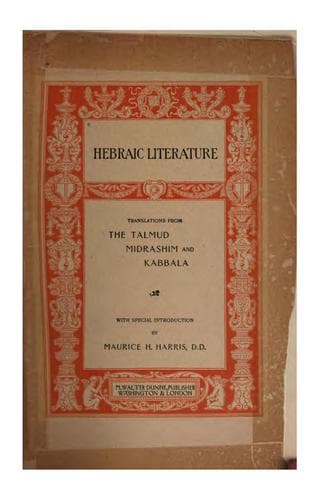
Hebraic Literature; Translations from the Talmud, Midrashim and Kabbala
Religion
Hebraic Literature; Translations from the Talmud, Midrashim and Kabbala
Hebrew literature -- Translations into English
"Sing and rejoice" (Zech. ii. 10). The Holy One--blessed be He!--will in
the future bring all the proselytes that were proselytized in this
world, and judge all the nations of the world in their presence. He will
say to them, "Why have ye left Me and served idols, which are nothing?"
They will reply and say, "Had we applied at Thy door, Thou wouldst not
have received us." Then will He say to them, "Let the proselytes that
were made from among you come forward and testify against you."
_P'sikta._
These are the pious female proselytes--Hagar, Osenath, Zipporah,
Shiphrah, Puah, the daughter of Pharaoh (Bathia), Rahab, Ruth, and Jael.
_Yalkut Yehoshua_, 9.
"The Lord keepeth the proselytes" (Ps. cxlvi. 9). "I esteem it a great
compliment on the part of the proselyte to leave his family and his
father's house and come to Me. Therefore I on My part will command
respecting him (Deut. x. 19), 'Love ye therefore the proselyted.'"
_Midrash Shochar Tov_, 146.
"I am a God near at hand" (Jer. xxiii. 23). "I am He who drew Jethro
near, and did not keep him at a distance"; therefore thou also when a
man comes to be proselytized in the name of Heaven, draw him near, do
not repulse him or keep him at a distance. From this thou art to learn
that while one repulses with the left hand he is to draw with the right,
and not as Elisha did. (He repulsed Gehazi with both hands.)
_Yalkut Jeremiah._
Showers of rain are greater than the giving of the Law, for the giving
of the Law was a gladsome event to Israel only, but rain is a cause of
joy to the wide world, including cattle, beasts, and fowls.
_Midrash Shochar Tov_, 117.
David was a shepherd of Israel, and the Shepherd of David was the Holy
One--blessed be He!--as it is said (Ps. xxiii. 1), "The Lord is my
Shepherd."
_Midrash Rabbah_, chap. 59.
Rav Pinchas says, "David in the Psalms calls five times upon the Holy
One--blessed be He!--to arise. (1.) 'Arise, O Lord; save me, O my God!'
(Ps. iii. 7). (2.) 'Arise, O Lord, in Thine anger!' (Ps. vii. 6). (3.)
'Arise, O Lord, let not man prevail!' (Ps. ix. 19). (4.) 'Arise, O Lord;
O God, lift up Thine hand: forget not the humble!' (Ps. x. 12). (5.)
'Arise, O Lord; disappoint him!' But the Holy One--blessed be He!--said
unto David, 'My son, though thou call upon Me many a time to arise, I
will not arise. But when do I arise? When thou seest the poor oppressed
and the needy sighing, then will I arise.'" This explains what is
written (Ps. xii. 5), "For the oppression of the poor, for the sighing
of the needy, now will I arise, saith the Lord."
_Bamidbar Rabbah_, chap. 75.
Public-domain text, read in full here on John Shaqi.
Reviews
Reviews
No reviews yet
Be the first to share your thoughts on this work.
Elsewhere in the archive
Join the Discussion
Join the discussion
Sign in to leave a comment or review.
Sign InorCreate an account