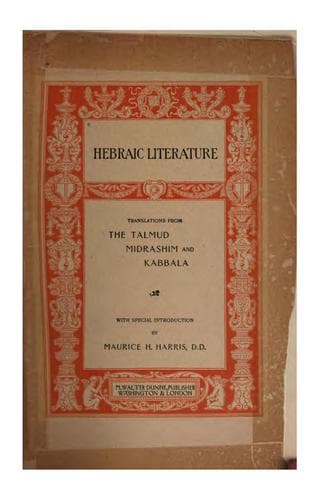
Hebraic Literature; Translations from the Talmud, Midrashim and Kabbala — John Shaqi
Hebraic Literature; Translations from the Talmud, Midrashim and Kabbala
Religion
Hebraic Literature; Translations from the Talmud, Midrashim and Kabbala
Hebrew literature -- Translations into English
If any two disciples of the wise, dwelling in the same city, have a
difference respecting the Halachah, let them remember what Scripture
denounces against them, "And also I gave them statutes that are not
good, and judgments by which they shall not live" (Ezek. xx. 25).
Ibid., fol. 32, col. 1.
If a man espouse one of two sisters, and does not know which he has
espoused, he must give both a bill of divorce. If two men espouse two
sisters, and neither of them know which he has espoused, then each man
must give two bills of divorce, one to each woman.
_Yevamoth_, fol. 23, col. 2.
There is a time coming (i.e., in the days of the Messiah), when a grain
of wheat will be as large as the two kidneys of the great ox.
_Kethuboth_, fol. 111, col. 1.
According to a recent discovery, which has been confirmed by
subsequent observation and experiment, wheat is a development by
cultivation of the tiny grain of the _Ægilops ovata_, a sort of
grass; but we are indebted to Rabbinic lore for the curious
information that before the Fall of man wheat grew upon a tree
whose trunk looked like gold, its branches like silver, and its
leaves like so many emeralds. The wheat ears themselves were as
red as rubies, and each bore five sparkling grains as white as
snow, as sweet as honey, and as fragrant as musk. At first the
grains were as big as an ostrich's egg, but in the time of Enoch
they diminished to the size of a goose's egg, and in Elijah's to
that of a hen, while at the commencement of the common era, they
shrank so small as not to be larger than grapes, according to a
law the inverse of the order of nature. Rabbi Yehudah
(_Sanhedrin_, fol. 70, col. 1) says that wheat was the forbidden
fruit. Hence probably the degeneracy.
Of two that quarrel, the one that first gives in shows the nobler
nature.
Ibid., fol. 71, col. 2.
He who sets aside a portion of his wealth for the relief of the poor
will be delivered from the judgment of hell. Of this the parable of the
two sheep that attempted to ford a river is an illustration; one was
shorn of its wool and the other not; the former, therefore, managed to
get over, but the latter, being heavy-laden, sank.
_Gittin_, fol. 7, col. 1.
Zoreah and Eshtaol (Josh. xv. 33) were two large mountains, but Samson
tore them up and grated the one against the other.
_Soteh_, fol. 9, col. 2.
Public-domain text, read in full here on John Shaqi.
Reviews
Reviews
No reviews yet
Be the first to share your thoughts on this work.
Join the Discussion
Join the discussion
Sign in to leave a comment or review.
Sign InorCreate an account