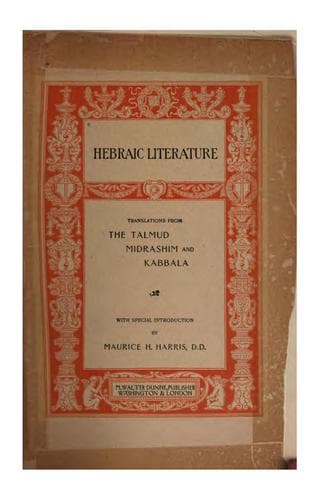
Hebraic Literature; Translations from the Talmud, Midrashim and Kabbala
Religion
Hebraic Literature; Translations from the Talmud, Midrashim and Kabbala
Hebrew literature -- Translations into English
The above tradition is founded on Judges xiii. 25, in which it
is said of Samson, "And the spirit of God began to move him at
times in the camp of Dan, between Zoreah and Eshtaol," in which
the word "move," signifies also to "strike a stroke," "step a
step," and "once." Founding on which last two meanings, Rabbi
Yehudah says, "Samson strode in one stride from Zoreah to
Eshtaol," a giant stride of two miles or more. Taking the word
in the sense of "strike," or "producing a ringing sound,"
another Rabbi tells us that the hairs of Samson's head stood
upright, tinkling one against another like bells, the jingle of
which might be heard from Zoreah to Eshtaol. The version in the
text takes the same word in the sense of to "strike together."
On the day when Isaac was weaned, Abraham made a great feast, to which
he invited all the people of the land. Not all of those who came to
enjoy the feast believed in the alleged occasion of its celebration, for
some said contemptuously, "This old couple have adopted a foundling, and
provided a feast to persuade us to believe that the child is their own
offspring." What did Abraham do? He invited all the great men of the
day, and Sarah invited their wives, who brought their infants, but not
their nurses, along with them. On this occasion Sarah's breasts became
like two fountains, for she supplied, of her own body, nourishment to
all the children. Still some were unconvinced, and said, "Shall a child
be born to one that is a hundred years old, and shall Sarah, who is
ninety years old, bear?" (Gen. xvii. 17.) Whereupon, to silence this
objection, Isaac's face was changed, so that it became the very picture
of Abraham's; then one and all exclaimed, "Abraham begat Isaac."
_Bara Metzia_, fol. 87, col. 1.
Rava relates the following in the name of Rabbi Yochanan:--"Two Jewish
slaves were one day walking along, when their master, who was following,
overheard the one saying to the other, 'There is a camel ahead of us, as
I judge--for I have not seen--that is blind of one eye and laden with
two skin-bottles, one of which contains wine and the other oil, while
two drivers attend it, one of them an Israelite, and the other a
Gentile.' 'You perverse men,' said their master, 'how can you fabricate
such a story as that?' The slave answered, and gave this as his reason,
'The grass is cropped only on one side of the track, the wine, that must
have dripped, has soaked into the earth on the right, and the oil has
trickled down, and may be seen on the left; while one of the drivers
turned aside from the track to ease himself, but the other has not even
left the road for the purpose.' Upon this the master stepped on before
them in order to verify the correctness of their inferences, and found
the conclusion true in every particular. He then turned back, and ...
after complimenting the two slaves for their shrewdness, he at once gave
them their liberty."
Public-domain text, read in full here on John Shaqi.
Reviews
Reviews
No reviews yet
Be the first to share your thoughts on this work.
Join the Discussion
Join the discussion
Sign in to leave a comment or review.
Sign InorCreate an account