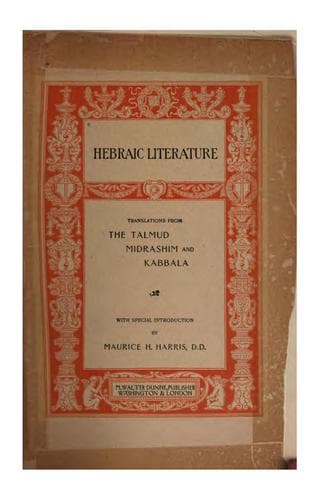
Hebraic Literature; Translations from the Talmud, Midrashim and Kabbala — John Shaqi
Hebraic Literature; Translations from the Talmud, Midrashim and Kabbala
Religion
Hebraic Literature; Translations from the Talmud, Midrashim and Kabbala
Hebrew literature -- Translations into English
_Sanhedrin_, fol. 104, col. 2.
When the disciples of Shamai and Hillel increased in Israel, contention
increased along with them, so much so, that the one law became as two
laws (and these contradictory).
_Soteh_, fol. 47, col. 2.
If two parties deposit money with a third, one a single manah and the
other two hundred, and both afterward appear and claim the larger sum,
the depositary should give each depositor one manah only, and leave the
rest undivided till the coming of Elijah.
_Bava Metzia_, fol. 37, col. 2.
"Till Elijah comes" is a phrase which is in use among the Jews
to express postponement forever, like _ad Kalendas Græcas_. It
is applied to questions that would take Elijah to settle, which,
it is believed, he will not appear to do till doomsday.
"And I will make thy windows of agates" (Isa. liv. 12). Two of the
angels in heaven, Gabriel and Michael, once disputed about this: one
maintained that the stone should be an onyx, and the other asserted it
should be a jasper; but the Holy One--blessed be He!--said unto them,
"Let it be as both say, which, in Hebrew, abbreviated, is an agate."
_Bava Bathra_, fol. 75, col. 1.
"The horseleech has two daughters, crying, Give! give!" (Prov. xxx. 15.)
Mar Ukva says, "This has reference to the voice of two daughters crying
out from torture in hell, because their voice is heard in this world
crying, 'Give! give!'--namely--heresy and officialism."
_Avodah Zarah_, fol. 17, col. 1.
Rashi says heresy here refers to the "heresy of James," or, in
other words, Christianity.
Two cemeteries were provided by the judicial authorities, one for
beheaded and strangled criminals, and the other for those that were
stoned or burned. When the flesh of these was consumed, they collected
the bones and buried them in their own place, after which the relations
came and saluted the judge and the witnesses, and said, "We owe you no
grudge, for you passed a just judgment."
_Sanhedrin_, fol. 46, col. 1.
Alas! for the loss which the world has sustained in the degradation of
the helpful serpent. If the serpent had not been degraded, every
Israelite would have been attended by two of kindly disposition, one of
which might have been sent to the north, and the other to the south, to
bring for its owner precious corals and costly stones and pearls.
_Sanhedrin_, fol. 59, col. 2.
Here are two or three other sayings from the Talmud relative to the
serpent.
Benjamin the son of Jacob, Amram the father of Moses, and Jesse the
father of David all died, not because of their own sin (for they had
none, says Rashi), but because of the (original) sin committed under the
serpent's temptation.
_Shabbath_, fol. 55, col. 2.
No man was ever injured by a serpent or scorpion in Jerusalem.
_Yoma_, fol. 21, col. 1.
Public-domain text, read in full here on John Shaqi.
Reviews
Reviews
No reviews yet
Be the first to share your thoughts on this work.
Join the Discussion
Join the discussion
Sign in to leave a comment or review.
Sign InorCreate an account