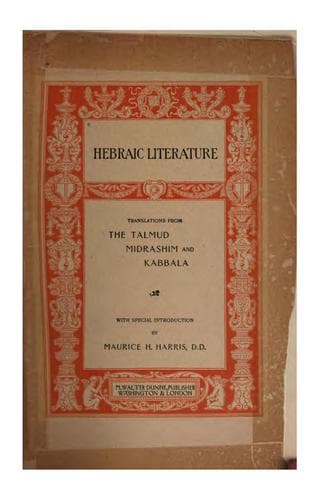
Hebraic Literature; Translations from the Talmud, Midrashim and Kabbala
Religion
Hebraic Literature; Translations from the Talmud, Midrashim and Kabbala
Hebrew literature -- Translations into English
"Fear not; I will go with thee, and I will speak in thy defense. I will
not leave thee until thou art delivered from thy trouble."
The "first friend" is a man's wealth, which he must leave behind him
when he dies. The "second friend" is typified by the relatives who
follow him to the grave and leave him when the earth has covered his
remains. The "third friend," he who entered with him into the presence
of the king, is as the good deeds of a man's life, which never desert,
but accompany him to plead his cause before the King of kings, who
regardeth not person nor taketh bribery.
Thus taught Rabbi Eleazer:--
"On this great and tearful day the angel Samal finds no blots, no sins
on Israel." Thus he addresses the Most High:--
"'O Sovereign Lord, upon the earth this day one nation pure and innocent
exists. Even as the angels is Israel on this Atonement Day. As peace
exists in heaven, so rests it now upon this people, praying to Thy Holy
Name.'
"God hears this testimony of His angel, and pardon's all His people's
sins."
But though the Almighty thus forgives our sins, we may not repeat them
with impunity, for "to such a one as saith, 'I will commit a sin and
repent,' there can be no forgiveness, no repentance."
FEAST OF TABERNACLES
The Feast of Tabernacles begins on the fifteenth day of the seventh
month, _Tishri_ (October), and during its continuance, seven days, the
Israelites are commanded to dwell in tabernacles or booths. This is
designed to keep fresh in their memory the tents with formed their homes
during their forty years' sojourn in the wilderness. The symbols of the
festival are branches of the palm, bound with sprigs of myrtle and
willow, and a citron.
The Lord said, "This is not to be to you a fast as the Day of Atonement;
eat, drink, be merry, and sacrifice peace-offerings thereon." The Bible
says, "Seven days unto the Lord"; therefore we should in all our
merriment devote a few serious thoughts to Him.
The Feast of Tabernacles is held in the autumn, after the fruits of the
field have been garnered in the storehouses, according to the words of
the Bible, "The Feast of Tabernacles shalt thou hold for thyself seven
days when thou hast gathered in the produce of thy thresh-floor and thy
wine-press."
This dwelling in booths is also to bring to mind the manner in which the
Israelites lived for forty years after they left Egypt. With merely
temporary walls to protect them from summer's heat and winter's cold,
from wind and storm. God was with them through all their generations,
and they were protected from all evil.
Public-domain text, read in full here on John Shaqi.
Reviews
Reviews
No reviews yet
Be the first to share your thoughts on this work.
Elsewhere in the archive
Join the Discussion
Join the discussion
Sign in to leave a comment or review.
Sign InorCreate an account