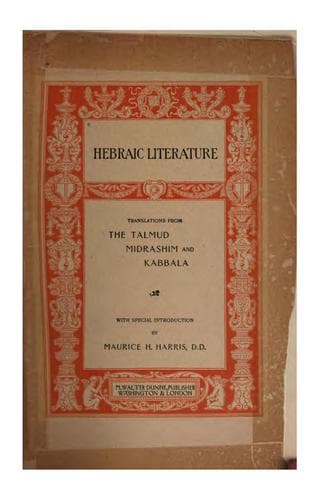
Hebraic Literature; Translations from the Talmud, Midrashim and Kabbala
Religion
Hebraic Literature; Translations from the Talmud, Midrashim and Kabbala
Hebrew literature -- Translations into English
According to the opinion of some of the Rabbis, the Israelites did not
really dwell in booths in the wilderness, but were surrounded by
clouds--by seven clouds. Four clouds, one at each of the four sides; a
fifth, a shadow, to protect them from the hot rays of the sun; the
sixth, a pillar of fire to give them light by night (they being able to
see as clearly by night as by day); and the seventh, to precede their
journeying and direct their way.
The children of Israel departed from Egypt in _Nissan_ (April), and
obtained immediately these booths, which they made use of for forty
years. Thus they were in booths during the entire cycle of the year, and
we could as easily commemorate this fact in the spring as in the fall,
in the summer as in the winter. Why, then, has God made autumn, and
neither spring nor summer, the season of observance? Because if we dwelt
in booths in the summer, it would be a question whether we did so in
obedience to God's behest or for our own gratification; for many people
seek airy retreats during this season; but in the fall, when the trees
lose their leaves, and the air grows cold and chilling, and it is the
time to fix our houses for the winter, then by inhabiting these
temporary residences, we display our desire to do as our Creator has
bidden us.
The Feast of Tabernacles is also the Feast of Ingathering, when we
should thank God for the kindness shown us and the treasure with which
He has blessed us. When the Eternal has provided man with his
sustenance, in the long evenings which follow he should meditate and
study his Bible, and make this indeed a "feast to the Lord," and not
entirely for personal gratification.
The four species belonging to the vegetable kingdom which we use in this
festival, are designed to remind us of the four elements of nature,
which work under the direction and approval of the Most High, and
without which all things would cease to exist. Therefore the Bible
commands us on this "feast of the Lord," to give thanks, and bring
before Him these four species, each typifying one of the elements.
"Ye shall take for yourselves the fruit of the tree _hadar_" (the
citron). Its color is high yellow and resembles fire. The second species
is the palm branch (Heb. _Lulab_). The palm is a high tree, growing up
straight in the air, and its fruit is sweet and delicious to the taste;
this then represents the second element, air. The third is the bough of
the myrtle, one of the lowliest of trees, growing close to the ground;
its nature, cold and dry as earth, fits it to represent that element.
The fourth is "the willow of the brook," which grows in perfection close
beside the water, dropping its branches into the stream, and symbolizing
thus the last element, water.
The Bible teaches us that for each of these four elements we owe special
thanks to God.
Public-domain text, read in full here on John Shaqi.
Reviews
Reviews
No reviews yet
Be the first to share your thoughts on this work.
Elsewhere in the archive
Join the Discussion
Join the discussion
Sign in to leave a comment or review.
Sign InorCreate an account