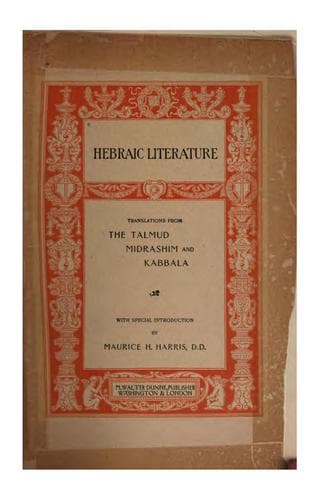
Hebraic Literature; Translations from the Talmud, Midrashim and Kabbala
Religion
Hebraic Literature; Translations from the Talmud, Midrashim and Kabbala
Hebrew literature -- Translations into English
The citron we hold in the left hand, and the other three we grasp
together in the right. This we do because the citron contains in itself
all that the others represent. The outside skin is yellow, fire; the
inside skin is white and damp, air; the pulp is watery, water; and the
seeds are dry, earth. It is taken into the left hand, because the right
hand is strongest, and the citron is but one, while the other emblems
are three.
These four emblems represent likewise the four principal members of the
human body. The citron is shaped somewhat like a heart, without which we
could not live, and with which man should serve his fellows; the palm
branch represents the spine, which is the foundation of the human frame,
in front of which the heart lies; this signifies that we should serve
God with our entire body. The branches of the myrtle resemble a human
eye, with which man recognizes the deeds of his fellows, and with which
he may obtain a knowledge of the law. The leaves of the willow represent
the lips, with which man may serve the Eternal and thank Him. The myrtle
is mentioned in the Bible before the willow, because we are able to see
and know a thing before we can call its name with our lips; man is able
to look into the Bible before he can study the same. Therefore, with
these four principal parts of the human frame should we praise the
Creator, as David said, "All my bones shall say, O Lord, who is like
unto Thee?"
Maimonides, in his work called _Moreh Nebuchim_ ("The Guide of the
Perplexed"), explains that God commanded the Israelites to take these
four emblems during this festival to remind them that they were brought
out from the wilderness, where no fruit grew, and no people lived, into
a land of brooklets, waters, a land flowing with milk and honey. For
this reason did God command us to hold in our hands the precious fruit
of this land while singing praises to Him, the One who wrought miracles
in our behalf, who feeds and supports us from the productiveness of the
earth.
The four emblems are different in taste, appearance, and odor, even as
the sons of men are different in conduct and habits.
The citron is a valuable fruit; it is good for food and has a most
pleasant odor. It is compared to the intelligent man, who is righteous
in his conduct toward God and his fellow-man. The odor of the fruit is
his good deeds; its substance is his learning, on which others may feed.
This is perfect among the emblems, and is, therefore, always mentioned
first, and taken by itself in one hand.
The palm branch brings forth fruit, but is without odor. It is compared
to those people who are learned, but who are wanting in good deeds; they
who know the law, but transgress its mandates.
The myrtle is compared to those people who are naturally good, who act
correctly toward God and man, but who are uneducated.
The willow of the brook has neither fruit nor odor; it is, therefore,
compared to the people who have no knowledge and who perform no good
deeds.
Public-domain text, read in full here on John Shaqi.
Reviews
Reviews
No reviews yet
Be the first to share your thoughts on this work.
Elsewhere in the archive
Join the Discussion
Join the discussion
Sign in to leave a comment or review.
Sign InorCreate an account