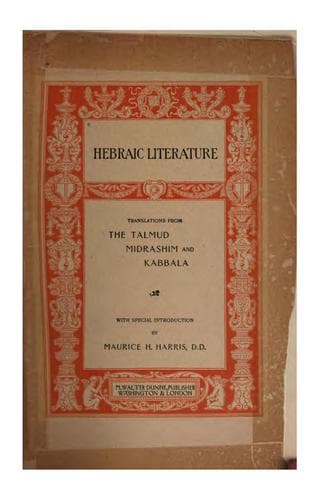
Hebraic Literature; Translations from the Talmud, Midrashim and Kabbala
Religion
Hebraic Literature; Translations from the Talmud, Midrashim and Kabbala
Hebrew literature -- Translations into English
Esther "stood in the inner court of the King's house" (Esth. v,
1). Rabbi Levi says, "When she reached the house of the images
the Shechinah departed from her. Then she exclaimed, 'My God! my
God! why hast thou forsaken me?'" (_Meggillah_, fol. 15, col. 2.)
"But ye that did cleave unto the Lord your God are alive every
one of you this day" (Deut. iv. 4). Is it possible to cleave to
the Shechinah? Is it not written (_ibid._, verse 24), "For the
Lord thy God is a consuming fire"? The reply is:--He that
bestows his daughter in marriage on a disciple of the wise (that
is, a Rabbi), or does business on behalf of the disciples of the
wise, or maintains them from his property, Scripture accounts it
as if he did cleave to the Shechinah. (_Kethuboth_, fol. iii,
col. 25.)
He who is angry has no regard even for the Shechinah; as it is
written (Ps. x. 4), "The wicked, when his anger rises, does not
inquire after God; God is not in all his thoughts." (_Nedarim_,
fol. 22, col. 2.)
He who visits the sick should not sit upon the bed, nor even
upon a stool or a chair beside it, but he should wrap his mantle
round him and sit upon the floor, because of the Shechinah which
rests at the head of the bed of the invalid; as it is written
(Ps. xli. 3), "The Lord will strengthen him upon the bed of
languishing." (Ibid., fol. 40, col. 1.)
When Israel went up out of the Red Sea, both the babe on its
mother's lap and the suckling at the breast saw the Shechinah,
and said, "This is my God, and I will prepare Him a habitation;"
as it is written (Ps. viii. 2), "Out of the mouths of babes and
sucklings thou hast ordained strength." (_Soteh_, fol. 30, col.
2.)
Where do we read that the Shechinah is present everywhere? In
Zech. ii. 3, where it is written, "And behold the angel that
talked with me went forth, and another angel went out to meet
him." It is not said went out after him, but "went out to meet
him." From this we know that the Shechinah is present
everywhere. (_Bava Bathra_ fol. 25, col. 1.)
Rabbi Akiva says, "For three things I admire the Medes:--1. When they
carve meat, they do it on the table; 2. When they kiss, they only do so
upon the hand; 3. And when they consult, they do so only in the field."
_Berachoth_, fol. 8, col. 2.
Public-domain text, read in full here on John Shaqi.
Reviews
Reviews
No reviews yet
Be the first to share your thoughts on this work.
Join the Discussion
Join the discussion
Sign in to leave a comment or review.
Sign InorCreate an account