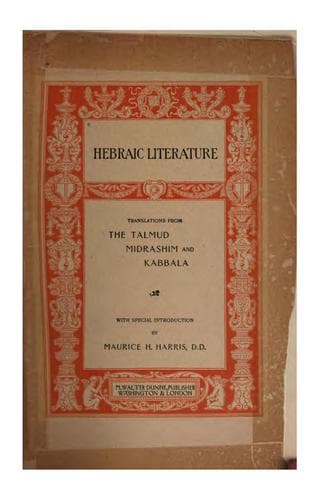
Hebraic Literature; Translations from the Talmud, Midrashim and Kabbala
Religion
Hebraic Literature; Translations from the Talmud, Midrashim and Kabbala
Hebrew literature -- Translations into English
The stone which Og, king of Bashan, meant to throw upon Israel is the
subject of a tradition delivered on Sinai. "The camp of Israel I see,"
he said, "extends three miles; I shall therefore go and root up a
mountain three miles in extent and throw it upon them." So off he went,
and finding such a mountain, raised it on his head, but the Holy
One--blessed be He!--sent an army of ants against him, which so bored
the mountain over his head that it slipped down upon his shoulders, from
which he could not lift it, because his teeth, protruding, had riveted
it upon him. This explains that which is written (Ps. iii. 7), "Thou
hast broken the teeth of the ungodly;" where read not "Thou hast
broken," but "Thou hast ramified," that is, "Thou hast caused to branch
out." Moses being ten ells in height, seized an axe ten ells long, and
springing up ten ells, struck a blow on Og's ankle and killed him.
Ibid., fol. 54, col. 2.
This same story is given with more than Talmudic exaggeration in
the Targum of Jonathan ben Uzziel, while the author of the Book
of Jasher (chap. lxv., verses 23, 24) makes the camp and the
mountain forty miles in extent. The giant here figures in
antediluvian tradition. He is said to have been saved at the
Flood by laying hold of the ark, and being fed day by day
through a hole in the side of the ark by Noah himself. A
tradition which says the soles of his feet were forty miles long
at once explains all the extraordinary feats ascribed to him.
Rav Yehudah used to say, "Three things shorten a man's days and
years:--1. Neglecting to read the law when it is given to him for that
purpose; seeing it is written (Deut. xxx. 20), 'For He (who gave it) is
thy life and the length of thy days.' 2. Omitting to repeat the
customary benediction over a cup of blessing; for it is written (Gen.
xii. 3), 'And I will bless them that bless thee.' 3. And the assumption
of a Rabbinical air; for Rabbi Chama bar Chanena says, 'Joseph died
before any of his brethren, because he domineered over them.'"
_Berachoth_, fol. 55, col. 1.
The first of these refers to the reading of the law in public
worship, the second to a practice after meals when more than two
adult Jews were present, and the third to the dictatorial air
often assumed by the Rabbis.
Three things proceed by pre-eminence from God Himself:--Famine, plenty,
and a wise ruler. Famine (2 Kings viii. 2): "The Lord hath called for a
famine;" plenty (Ezek. xxxvi. 29): "I will call for corn and increase
it;" a wise ruler; for it is written (Exod. xxxi. 2), "I have called by
name Bezaleel." Rabbi Yitzchak says, "A ruler is not to be appointed
unless the community be first consulted. God first consulted Moses, then
Moses consulted the nation concerning the appointment of Bezaleel."
Ibid., fol. 55, col. 1.
Public-domain text, read in full here on John Shaqi.
Reviews
Reviews
No reviews yet
Be the first to share your thoughts on this work.
Join the Discussion
Join the discussion
Sign in to leave a comment or review.
Sign InorCreate an account