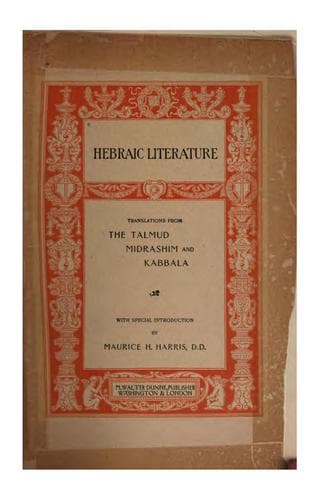
Hebraic Literature; Translations from the Talmud, Midrashim and Kabbala
Religion
Hebraic Literature; Translations from the Talmud, Midrashim and Kabbala
Hebrew literature -- Translations into English
There are three whom the Holy One--blessed be He!--Himself proclaims
virtuous:--The unmarried man who lives in a city and does not sin; the
poor man who restores a lost thing which he has found to its owner; and
the rich man who pays the tithes of his increase unostentatiously. Rav
Saphra was a bachelor, and he dwelt in a large city. A disciple of the
wise once descanted upon the merits of a celibate life in the presence
of Rava and this Rav Saphra, and the face of the latter beamed with
delight. Remarking which, Rava said to him, "This does not refer to such
a bachelor as thou art, but to such as Rabbi Chanena and Rabbi Oshaia."
They were single men, who followed the trade of shoemakers, and dwelt in
a street mostly occupied by _meretrices_, for whom they made shoes; but
when they fitted these on, they never raised their eyes to look at their
faces. For this the women conceived such a respect for them, that when
they swore, they swore by the life of the holy Rabbis of the land of
Israel.
_Psachim_, fol. 113, cols, 1, 2.
There are three whom the Holy One--blessed be He!--abhorreth: He who
says one thing but thinks another; he who might bear witness in favor of
his neighbor but refrains from doing so; and he who, having seen his
neighbor act disgracefully, goes and appears singly as a witness against
him (thus only condemning, but not convicting, him, as the law requires
two witnesses). As, for example, when Toviah transgressed and Zigud
appeared against him singly before Rav Pappa, and Rav Pappa ordered this
witness to receive forty stripes save one in return. "What!" said he,
"Toviah has sinned, and should Zigud be flogged?" "Yes," replied the
Rabbi, "for by testifying singly against him thou bringest him only into
bad repute." (See Deut. xix. 15.)
_P'sachim_ fol. 113, col. 2.
"Toviah has sinned and Zigud is flogged," has long been a
proverb among Jews.
There are three whose life is no life:--The sympathetic, the irascible,
and the melancholy.
_P'sachim_, fol. 113, col. 2.
There are three which despise their fellows:--Dogs, cocks, and
sorcerers. Some say strange women also, and some the disciples of the
Babylonian Rabbis.
Ibid.
These three love their fellows:--Proselytes, slaves, and ravens.
Ibid.
These three are apt to strut:--Israel among the nations, the dog among
animals, the cock among birds. Some say also the goat among small
cattle, and some the caper shrub among trees.
Ibid., fol. 25, col. 2.
There are three whose life is no life:--He who lives at another's table;
he whose wife domineers over him; and he who suffers bodily affliction.
Some say also he who has only a single shirt in his wardrobe.
Ibid., fol. 32, col. 2.
Three things are said respecting the finger-nails:--He who trims his
nails and buries the parings is a pious man; he who burns these is a
righteous man; but he who throws them away is a wicked man, for
mischance might follow, should a female step over them.
_Moed Katan_, fol. 18, col. 1.
Public-domain text, read in full here on John Shaqi.
Reviews
Reviews
No reviews yet
Be the first to share your thoughts on this work.
Join the Discussion
Join the discussion
Sign in to leave a comment or review.
Sign InorCreate an account