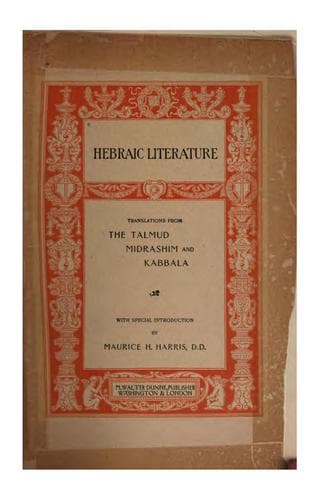
Hebraic Literature; Translations from the Talmud, Midrashim and Kabbala
Religion
Hebraic Literature; Translations from the Talmud, Midrashim and Kabbala
Hebrew literature -- Translations into English
Rabbi Abba, in the name of Shemuel, says, "The schools of Shammai and
Hillel were at variance three years, the one party contending and
saying, 'The Halacha is according to us;' and the other, 'The Halacha is
according to us.' Then came a voice from the Lord and said, 'Both these
and those are the words of the living God, but yet the Halacha is
according to the school of Hillel.' What was the merit of the school of
Hillel that the Halacha should be pronounced to be according to it? Its
disciples were gentle and forbearing, for while they stood by their own
decisions, they also stated those maintained by the school of Shammai,
and often even mentioned the tenets of the school of Shammai first and
their own afterward. This teaches us that him who humbles himself, God
will exalt; and him who exalts himself, God will abase. Whoso pursueth
greatness, greatness will flee from him; and whoso fleeth from
greatness, greatness will pursue him."
_Eiruvin_, fol. 13, col. 2.
There are three entrances to hell:--One in the desert, one in the sea,
and one in Jerusalem.
Ibid., fol. 19, col. i.
These three will never see hell:--He who is purified by poverty; he who
is purged by a painful flux; and he who is harassed by importunate
creditors; and some say, he also who is plagued with a termagant wife.
_Eiruvin_, fol. 41, col. 2.
Three effects are ascribed to Babylonian broth (which was made of moldy
bread, sour milk, and salt):--It retards the action of the heart, it
affects the eyesight, and emaciates the body.
_P'sachim_, fol. 42, col 1.
These three are not permitted to come between two men, nor is a man
allowed to pass between any two of these three:--A dog, a palm tree, or
a woman; to which some add the pig, and others the serpent as well.
Ibid., fol. 111, col. 1.
One part of this regulation is rather hard and should surely be
abolished; that, viz, which ordains a woman shall not come
between two men or a man pass between two women. The compiler of
this Miscellany was once witness to a case which illustrates its
inconvenience: it occurred at Tiberias. A pious young Jew who
had to traverse a narrow road to pass from the lake to the town
was kept standing for a very considerable time under a broiling
sun, simply because two young women, to tease him, guarded the
entrance, and dared him to pass between them. Of course he dared
not accept the challenge, otherwise he would have incurred the
penalty of death, according to the judgment of the Talmud; for
"Whosoever transgresses any of the words of the Scribes is
guilty of death." (_Eiruvin_, fol. 21, col. 2.)
These three will inherit the world to come:--He who dwells in the land
of Israel; he who brings up his sons to the study of the law; and he who
repeats the ritual blessing over the appointed cup of wine at the close
of the Sabbath.
_P'sachim_, fol. 113, col. 1.
Public-domain text, read in full here on John Shaqi.
Reviews
Reviews
No reviews yet
Be the first to share your thoughts on this work.
Join the Discussion
Join the discussion
Sign in to leave a comment or review.
Sign InorCreate an account