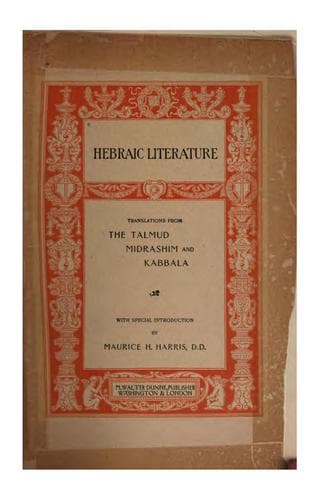
Hebraic Literature; Translations from the Talmud, Midrashim and Kabbala
Religion
Hebraic Literature; Translations from the Talmud, Midrashim and Kabbala
Hebrew literature -- Translations into English
He delivered to the children he had by Keturah a secret name, with which
they learned to practice witchcraft and do the works of the devil.
_Sanhedrin_, fol. 91, col. 1.
Though great, he personally waited on his guests, who had the appearance
of Arabs and not of angels.
_Kiddushin_, fol. 32, col. 2.
Rabbi Yehudah says Abraham planted an ornamental garden with all kinds
of choice fruits in it, and Rabbi Nehemiah says he erected an inn for
travelers in order to make known the name of God to all who sojourned in
it.
_Soteh_, fol. 10, col. 1.
Both the Targum of Ben Uzziel and the Yerushalmi say that
Abraham planted a paradise at Beersheba for the entertainment
and delectation of his guests; and in Jasher (chap, xxvii. verse
37) it is said that "Abraham formed a grove and planted a
vineyard there, and had always ready in his tent meat and drink
for those that passed through the land, so that they might
satisfy themselves in his house."
He ranked as one of the seven shepherds of Israel (Micah v. 5). In this
group David was the central figure, with Adam, Seth, and Methusaleh on
his right hand, and Abraham, Jacob, and Moses on his left.
_Succah_, fol. 52, col. 2.
The coin of Jerusalem had the impress of David and Solomon on the one
side, and the holy city of Jerusalem on the other. But the impress on
the coin of our father Abraham was an old man and an old woman on one
side, and a young man and a damsel on the other.
_Bava Kama_, fol. 37, col. 2.
This, it is to be presumed, must be taken in some symbolical
sense, for coins cannot be traced back to a date so early as
this; and when Abraham purchased the cave to bury Sarah in from
the sons of Heth, we read that he weighed to Ephron the silver.
Abraham pleaded with God on the behalf of Israel and said, "While there
is a Temple they will get their sins atoned for, but when there shall be
no Temple, what will become of them?" God, in answer to his prayer,
assured him that He had prepared a prayer for them, by which, as often
as they read it, He would be propitiated and would pardon all their
sins.
_Meggillah_, fol. 31, col. 2.
He was punished by his posterity being compelled to serve the Egyptians
two hundred and ten years, because he had pressed the Rabbis under his
tuition into military service in the expedition he had undertaken to
recover Lot from those who had carried him off captive; for it is
written (Gen. xiv. 14), "He armed his instructed." Samuel says Abraham
was punished because he perversely distrusted the assurance of God; as
it is written (Gen. xv. 8), "Whereby shall I know that I shall inherit
it?"
_Nedarim_, fol. 31, col. 2.
Abraham was thrown into a fiery furnace by Nimrod, and God would not
permit Gabriel to rescue him, but did so Himself; because God is One and
Abraham was one, therefore it behooved the One to rescue the one.
_P'sachim_, fol. 118, col. 1.
Public-domain text, read in full here on John Shaqi.
Reviews
Reviews
No reviews yet
Be the first to share your thoughts on this work.
Join the Discussion
Join the discussion
Sign in to leave a comment or review.
Sign InorCreate an account