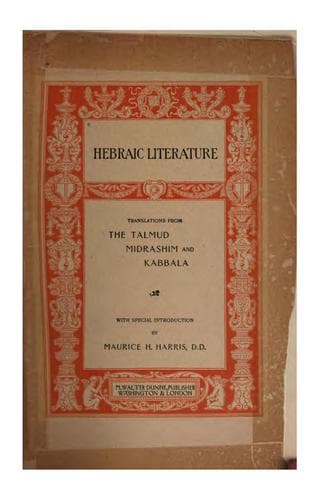
Hebraic Literature; Translations from the Talmud, Midrashim and Kabbala — John Shaqi
Hebraic Literature; Translations from the Talmud, Midrashim and Kabbala
Religion
Hebraic Literature; Translations from the Talmud, Midrashim and Kabbala
Hebrew literature -- Translations into English
The fire from which Abraham is here said to be delivered may
simply refer to his deliverance by the hand of God from Ur of
the Chaldees; Ur meaning "fire," and being the name of a place
celebrated for fire worship. The Midrash (p. 20) says, "When the
wicked Nimrod cast Abraham into the furnace, Gabriel said, 'Lord
of the universe! permit me to deliver this holy one from the
fire!' But the Lord made answer, 'I am the One Supreme in my
world, and he is supreme in his; it is fitting therefore that
the Supreme should rescue the supreme.'"
Abraham was a giant of giants; his height was as that of seventy-four
men put together. His food, his drink, and his strength were in the
proportion of seventy-four men's to one man's. He built an iron city for
the abode of his seventeen children by Keturah, the walls of which were
so lofty that the sun never penetrated them: he gave them a bowl full of
precious stones, the brilliancy of which supplied them with light in the
absence of the sun.
_Sophrim_, chap. 21.
Abraham our father had a precious stone suspended from his neck, and
every sick person that gazed upon it was immediately healed of his
disease. But when Abraham died, God hung up the stone on the sphere of
the sun.
_Bava Bathra_, fol. 16, col. 2.
Till Abraham's time there was no such thing as a beard; but as many
mistook Abraham for Isaac, and Isaac for Abraham, they looked so exactly
alike, Abraham prayed to God for a beard to enable people to distinguish
him from his son, Isaac, and it was granted him; as it is written (Gen.
xxiv. 1), "And to Abraham a beard came when he was well stricken in
age."
_Sanhedrin_, fol. 107, col. 2.
Here the word which the translators of the English version
render "was old," is taken in another of its cognate meanings as
a beard. The Midrash is a trifle more modest in this legendary
assertion. There we read, "Before Abraham there was no special
mark of old age," and that for distinction's sake "the beard was
made to turn gray."
When he died, all the chiefs of the nations of the world stood in a line
and exclaimed, "Alas for the world that has lost its leader! Alas for
the ship that has lost its helmsman!"
_Bava Bathra_, fol. 91, col. 2.
As Rabbi Banna went about to measure and to mark off the outward and
inward dimensions of the different caves, when he came to the cave of
Machpelah he found Eliezar, Abraham's servant, at the entrance, and
asked him, "What is Abraham doing?" The answer he received was, "He is
asleep in the arms of Sarah."
Ibid., fol. 58, col. 1.
Abraham being greater than Moses, for while the latter is only
called by God "My Servant" (Mal. iv. 4), the former is called
"My Friend" (Isa. xli. 8), we devote a little more space for a
few more extracts from other Jewish sources than the Talmud, in
order to make the picture they supply of Abraham's character a
little more complete.
Public-domain text, read in full here on John Shaqi.
Reviews
Reviews
No reviews yet
Be the first to share your thoughts on this work.
Join the Discussion
Join the discussion
Sign in to leave a comment or review.
Sign InorCreate an account