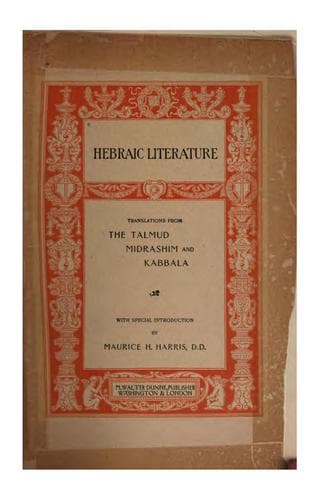
Hebraic Literature; Translations from the Talmud, Midrashim and Kabbala
Religion
Hebraic Literature; Translations from the Talmud, Midrashim and Kabbala
Hebrew literature -- Translations into English
I have already referred to the literature that has grown out of the
Talmud. The "Jewish Encyclopedia" treats every law recognized by nations
from the Talmudic stand-point. This will give the world a complete
Talmudic point of view. In speaking of it as literature, it lacks
perhaps that beauty of form in its language which the stricter demand as
literature _sine qua non_, and yet its language is unique. It is
something more than terse, for many a word is a whole sentence. Written
in Aramaic, it contains many words in the languages of the nations with
whom Israel came in contact--Greek, Roman, Persian, and words from other
tongues.
Like the Jew, the Talmud has had a history, almost as checkered as that
of its creator. Like him it was singled out for persecution. Louis IX.
burned twenty-four cart-loads of Talmuds in Paris. Its right of survival
had often been wrested through church synods and councils. It has been
banned, it has been excommunicated, it has been made the subject of
popish bulls; but it was in the sixteenth century that the Benedictine
Monks made a particular determined effort to destroy it. Fortunately
they knew not the times. It was the age of Humanism, the forerunner of
the Reformation, and the Talmud found its ablest defender in the great
Christian humanist, John Reuchlin. He was the one first to tell his
co-religionists, "Do not condemn the Talmud before you understand it.
Burning is no argument. Instead of burning all Jewish literature, it
were better to found chairs in the universities for its exposition." The
cause of liberality and light gained the day, and the printing-press
decided the perpetuation of the Talmud.
In the second stage of its persecution the censor figures. His
Philistine pen passed ruthlessly over everything that seemed to hint at
criticism of the Church; but not content with expunging the heretical
and the inferentially heretical, the censor at times went even so far as
to erase sentiments particularly lofty, in order that the Talmud should
not have the credit of expounding noble doctrine, nor the Jew the
advantage of studying it.
Public-domain text, read in full here on John Shaqi.
Reviews
Reviews
No reviews yet
Be the first to share your thoughts on this work.
Join the Discussion
Join the discussion
Sign in to leave a comment or review.
Sign InorCreate an account