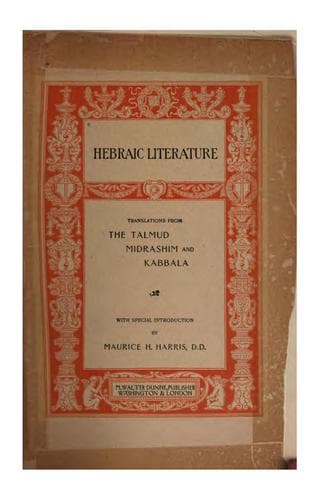
Hebraic Literature; Translations from the Talmud, Midrashim and Kabbala
Religion
Hebraic Literature; Translations from the Talmud, Midrashim and Kabbala
Hebrew literature -- Translations into English
But the latest stage of its persecution belongs to more modern days,
when inquisitions were out of date and monkish claws were cut. The
traducer would spitefully engage the services of some renegade Jew, to
gather from the Talmud all portions and passages that might seem
grotesque and ridiculous, so that the world might form an unfavorable
impression of the Talmud and of the people who treasure it. This has
been done with so much success that up till very recently the Gentile
world, including the Christian clergy, knew of the Talmud only through
these unfortunate perversions and caricatures. Imagine the citation of a
chapter from _Leviticus_ and one from _Chronicles_, of some vindictive
passages in the _Psalms_, of a few skeptical bits in _Ecclesiastes_ and
_Job_, and one or two of the barbaric stories in _Judges_, to be offered
to the world as a fair picture of the Bible, and you will understand the
sort of treatment the Talmud has received from the world at large and
the kind of estimate it has been given opportunity to form.
What is the value of the Talmud for the Jew? Certainly its greatest
value was rendered in the Middle Ages, when literature was scant and
copies of the few books in existence were rarer. When the Jew was shut
out of the world's pleasure and the world's culture and barred up in
Ghetto slums, then it was that the Talmud became his recreation and his
consolation, feeding his mind and his faith. In this way it not only
became in the Middle Ages a picture of the Jew, but largely formed his
character. It made him a keen dialectician, tempered with a thoughtful
and poetic touch. It fostered his patience and his humor and kept vivid
his ideals. It linked him with the Orient, while living in the Occident
and made him a bridge between the old and the new.
To the world at large it has great value archæologically. Here are
preserved ancient laws, glint lights on past history, forgotten forms in
the classic tongues, and pictures of old civilization. No one criticism
can cover the whole work. It is so many-sided. It includes so many
different standards of worth and value. If we take it as a whole, it is
good, it is bad and indifferent; it is trash and it is treasure; it is
dust and it is diamonds; it is potsherd and it is pearls; and in the
hands of impartial scholars, it is one of the great monuments of mental
achievement, one of the world's wonders.
Maurice H. Harris
THE TALMUD
* * * * *
Where do we learn that the Shechinah rests even upon one who studies the
law? In Exodus xx. 24, where it is written, "In all places where I
record my name I will come unto thee, and I will bless thee."
_Berachoth_, fol. 6, col. 1.
One pang of remorse at a man's heart is of more avail than many stripes
applied to him. (See Prov. xvii. 10.)
Ibid., fol. 7, col. 1.
Public-domain text, read in full here on John Shaqi.
Reviews
Reviews
No reviews yet
Be the first to share your thoughts on this work.
Join the Discussion
Join the discussion
Sign in to leave a comment or review.
Sign InorCreate an account