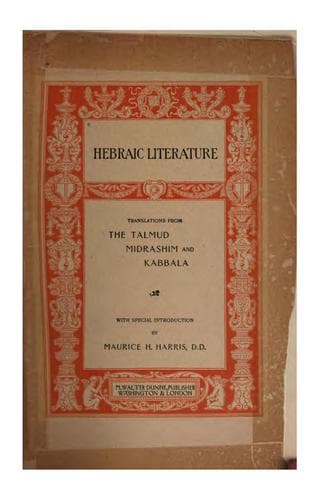
Hebraic Literature; Translations from the Talmud, Midrashim and Kabbala
Religion
Hebraic Literature; Translations from the Talmud, Midrashim and Kabbala
Hebrew literature -- Translations into English
_Yoma_, fol. 2, col. 1.
They associated with the high priest the senior elders of the Sanhedrin,
who read over to him the _agenda_ of the day, and then said to him, "My
lord high priest, read thou for thyself; perhaps thou hast forgotten it,
or maybe thou hast not learned it at all." On the day before the Day of
Atonement he was taken to the East Gate when they caused oxen, rams, and
lambs to pass before him, that he might become well-versed and expert in
his official duties. During the whole of the seven (preparatory) days
neither victuals nor drink were withheld from him, but toward dusk on
the eve of the Day of Atonement they did not allow him to eat much, for
much food induces sleep. Then the elders of the Sanhedrin surrendered
him to the elders of the priesthood, and these conducted him to the hall
of the house of Abtinas, and there they swore him in; and after bidding
him good-bye, they went away. In administering the oath they said, "My
lord high priest, we are ambassadors of the Sanhedrin; thou art our
ambassador and the ambassador of the Sanhedrin as well. We adjure thee,
by Him who causes His name to dwell in this house, that thou alter not
anything that we have told thee!" Then they parted, both they and he
weeping. He wept because they suspected he was a Sadducee, and they wept
because the penalty for wrongly suspecting persons is scourging. If he
was a learned man he preached (during the night); if not, learned men
preached before him. If he was a ready reader, he read; if not, others
read to him. What were the books read over to him? Job, Ezra, and the
Chronicles. Zechariah the son of Kevootal says, "I have often read
before him the Book of Daniel." If he became drowsy, the juniors of the
priestly order fillipped their middle fingers before him, and said, "My
lord high priest, stand up and cool thy feet upon the pavement." Thus
they kept him engaged till the time of slaughtering (the sacrifices).
_Yoma_, fol. 18, cols, 1, 2; fol. 19, col. 2.
Sacerdos nascitur, non fit,--a priest is born, not made, we may
truly say, just altering one word of a well-known proverb. His
father was a priest, and so were his forefathers as far back as
the time of Aaron; his sons and his sons' sons after him will
belong to the priestly order, and so the name was far too often
only the badge for exclusive and hereditary privilege. This
rule, that applies to the priests, holds good also with regard
to the Levites. (_Berachoth_, fol. 29, col. 1.)
There was a town in the land of Israel called Gophnith, where there were
eighty couples of brother priests who married eighty couples of sister
priestesses in one night.
_Berachoth_ fol. 44, col. 1.
Flay a carcass and take thy fee, but say not it is humiliating because I
am a priest, I am a great man.
_P'sachim_, fol. 113, col. 1.
Philo Judæus, De Sac. Honor, (p. 833), says, "The hides of the
burnt-offerings proved a rich perquisite of the priesthood."
Public-domain text, read in full here on John Shaqi.
Reviews
Reviews
No reviews yet
Be the first to share your thoughts on this work.
Elsewhere in the archive
Join the Discussion
Join the discussion
Sign in to leave a comment or review.
Sign InorCreate an account