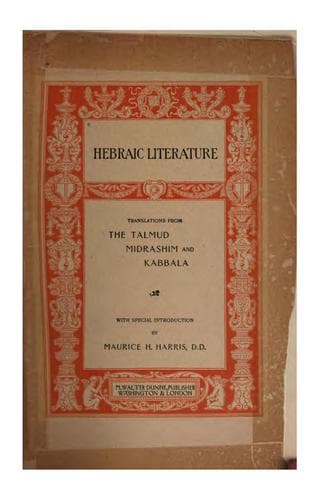
Hebraic Literature; Translations from the Talmud, Midrashim and Kabbala
Religion
Hebraic Literature; Translations from the Talmud, Midrashim and Kabbala
Hebrew literature -- Translations into English
Once a Jewish mother with her seven sons suffered martyrdom at the hands
of the Emperor. The sons, when ordered by the latter to do homage to the
idols of the Empire, declined, and justified their disobedience by
quoting each a simple text from the sacred Scriptures. When the seventh
was brought forth, it is related that Caesar, for appearance' sake,
offered to spare him if only he would stoop and pick up a ring from the
ground which had been dropped on purpose. "Alas for thee, O Caesar!"
answered the boy; "if thou art so zealous for thine honor, how much more
zealous ought we to be for the honor of the Holy One--blessed be He!" On
his being led away to the place of execution, the mother craved and
obtained leave to give him a farewell kiss. "Go, my child," said she,
"and say to Abraham, Thou didst build an altar for the sacrifice of one
son, but I have erected altars for seven sons." She then turned away and
threw herself down headlong from the roof and expired, when the echo of
a voice was heard exclaiming (Ps. cxiii. 9), "The joyful mother of
children" (or, the mother of the children rejoiceth).
_Gittin_, fol. 57, col. 2.
The story of this martyrdom is narrated at much greater length
in the Books of Maccabees (Book iii. chap. 7, Book iv. chaps.
8-18). In a Latin version the names are given, that of the
mother Solomona, and her sons respectively Maccabeus, Aber,
Machir, Judas, Achaz, Areth, while the hero of our Talmudic
reference, the seventh and last, is styled Jacob. Josephus,
Ant., Book xii. chap. 6, sec. 4, may also be referred to for
further and varying details.
The land of Israel was not destroyed till the seven courts of judgment
had fallen into idolatry, and these are they:--Jeroboam, the son of
Nebat; Baasha, the son of Ahijah; Ahab, the son of Omri; Jehu, the son
of Nimshi; Pekah, the son of Remaliah; Menahem, the son of Gadi; and
Hoshea, the son of Elah; as it is written (Jer. xv. 9), "She that hath
borne seven languisheth: she hath given up the ghost; her sun is gone
down while it is yet day; she hath been ashamed and confounded."
_Gittin_, fol. 88, col. 1.
"He stood and measured the earth; he beheld and freed the Gentiles
(A.V., he drove asunder the nations, Hab. iii. 6); he beheld that the
seven precepts which the children of Noah accepted were not observed; he
stood up and set their property free for the service of Israel."
_Bava Kama_, fol. 38, col. 1.
Public-domain text, read in full here on John Shaqi.
Reviews
Reviews
No reviews yet
Be the first to share your thoughts on this work.
Elsewhere in the archive
Join the Discussion
Join the discussion
Sign in to leave a comment or review.
Sign InorCreate an account