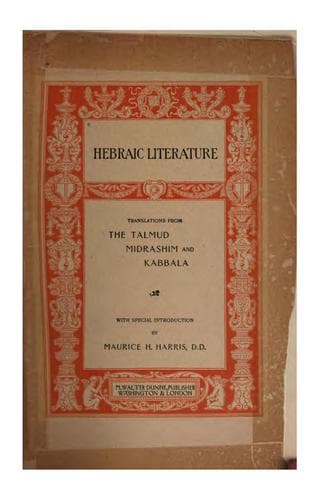
Hebraic Literature; Translations from the Talmud, Midrashim and Kabbala
Religion
Hebraic Literature; Translations from the Talmud, Midrashim and Kabbala
Hebrew literature -- Translations into English
This is one of the weightier expositions met with from time to
time in the Talmud, in which one recognizes a more than
ordinarily deep and earnest feeling on the part of the
commentator. The interpreter expresses himself as a man instinct
with the exclusive Hebrew spirit, and as such claims his title
to the whole inheritance. It is a claim abstractly defensible,
and the just assertion of it is the basis of all rights over
others. The only question here is whether the Jew alone is
invested with the privilege. There can be little doubt that the
principle on which he claims enfeoffment in the estate is a
sound one, that the earth belongs in no case to the sons of
Belial, only to the sons of God.
Seven things distinguish an ill-bred man and seven a wise man:--The wise
man (1.) does not talk before his superior in wisdom and years; (2.) he
does not interrupt another when speaking; (3.) he is not hasty to make
reply; (4.) his questions are to the point, and his answers are
according to the Halachah; (5.) his subjects of discourse are orderly
arranged, the first subject first and the last last; (6.) if he has not
heard of a thing, he says, I have not heard it; and (7.) he confesseth
the truth. The characteristics of the ill-bred man are just the contrary
of these.
_Avoth_, chap. 5, mish. 10.
If a man does not work during the six days of the week, he may be
obliged to work all the seven.
_Avoth d'Rab. Nathan_, chap. 11.
Seven have no portion in the world to come:--A notary; a schoolmaster,
the best of physicians, a judge who dispenses justice in his own native
town, a wizard, a congregational reader (or law-officer), and a butcher.
_Avoth d Rab. Nathan_, chap. 37.
Seven attributes avail before the Throne of Glory, and these
are:--Wisdom, righteousness, judgment, grace, mercy, truth, and peace.
Ibid., chap. 36.
There are seven points in which a righteous man excels another:--(1.)
The wife of the one is more comely than the other's; (2.) so are the
children of the one as compared with those of the other; (3.) if the two
partake of one dish, each enjoys the taste according to his doings; (4.)
if the two dye in one vat, by one the article is dyed properly, by the
other not; (5, etc.) the one excels the other in wisdom, in
understanding, in knowledge, and stature, as it is said (Prov. xii. 26),
"The righteous is more excellent than his neighbor."
Ibid., chap. 37.
Seven patriarchs were covenant-makers:--Abraham, Isaac, and Jacob,
Moses, Aaron, Phinehas, and David.
_Derech Eretz Zuta_, chap. 1.
Seven liquids are comprehended under the generic term drink (Lev. xi.
34):--Dew, water, wine, oil, blood, milk, and honey.
_Machshirin_, chap. 6, mish 6.
Public-domain text, read in full here on John Shaqi.
Reviews
Reviews
No reviews yet
Be the first to share your thoughts on this work.
Elsewhere in the archive
Join the Discussion
Join the discussion
Sign in to leave a comment or review.
Sign InorCreate an account