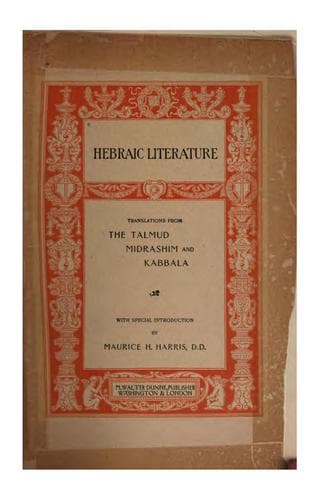
Hebraic Literature; Translations from the Talmud, Midrashim and Kabbala
Religion
Hebraic Literature; Translations from the Talmud, Midrashim and Kabbala
Hebrew literature -- Translations into English
So the Rabbi prayed for them to the Lord, who
couples and setteth the single in families. He then spoke his
blessing over the wife, who became thenceforth as a fruitful
vine, and honored her husband with children and children's
children.
A parallel to this, illustrative of wifely devotion, is recorded
in the early history of Germany. In the year 1141, during the
civil war in Germany between the Guelphs and the Ghibellines, it
happened that the Emperor Conrad besieged the Guelph Count of
Bavaria in the Castle of Weinsberg. After a long and obstinate
defense the garrison was obliged at length to surrender, when
the Emperor, annoyed that they had held out so long and defied
him, vowed that he would destroy the place with fire and put all
to the sword except the women, whom he gallantly promised to let
go free and pass out unmolested. The Guelph Countess, when she
heard of this, begged as a further favor that the women might be
allowed to bear forth as much of their valuables as they could
severally manage to carry. The Emperor having pledged his word
and honor that he would grant this request, on the morrow at
daybreak, as the castle gates opened, he saw to his amazement
the women file out one by one, every married woman carrying her
husband with her young ones upon her back, and the others each
the friend or relation nearest and dearest to her. At sight of
this, the Emperor was tenderly moved, and could not help
according to the action the homage of his admiration. The result
was that not only was life and liberty extended to the Guelphs,
but the place itself was spared and restored in perpetuity to
its heroic defenders. The Count and his Countess were henceforth
treated by the Emperor with honor and affection, and the town
itself was for long after popularly known by the name of
Weihertreue, i.e., the abode of womanly fidelity.
Benedictory condolences are recited by ten men, not reckoning the
mourners; but nuptial blessings are recited by ten men, including the
bridegroom.
_Kethuboth_, fol. 8. col. 2.
Public-domain text, read in full here on John Shaqi.
Reviews
Reviews
No reviews yet
Be the first to share your thoughts on this work.
Elsewhere in the archive
Join the Discussion
Join the discussion
Sign in to leave a comment or review.
Sign InorCreate an account