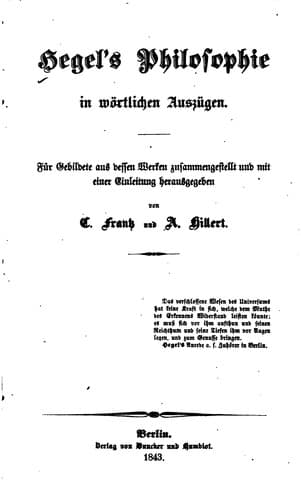
Hegel's Lectures on the History of Philosophy: Volume 3 (of 3)Hegel, Georg Wilhelm Friedrich
PhilosophyPhilosophy
Hegel's Lectures on the History of Philosophy: Volume 3 (of 3)
Hegel, Georg Wilhelm Friedrich
Philosophy -- History
If we cast a glance back over the period just traversed, we find that
in it a turning-point had been reached, that the Christian religion
had placed its absolute content in the mind and will of man, and that
it was thus, as a divine and supersensuous content, separated from the
world and shut up within itself in the centre-point of the individual.
Over against the religious life an external world stood as a natural
world—a world of heart or feeling, of desire, of human nature—which
had value only in as far as it was overcome. This mutual independence
of the two worlds had much attention bestowed on it throughout the
Middle Ages; the opposition was attacked on all quarters and in the end
overcome. But since the relation of mankind to the divine life exists
upon earth, this conquest at first presented the appearance of bringing
with it the destruction of the church and of the eternal through the
sensuous desires of man. The eternal truth was likewise grafted upon the
dry, formal understanding, so that we might say that the separation of
self-consciousness has in itself disappeared, and thereby a possibility
has been given of obtaining reconciliation. But because this implicit
union of the Beyond and the Here was of so unsatisfactory a nature that
the better feelings were aroused and forced to turn against it, the
Reformation made its appearance, partly, no doubt, as a separation from
the Catholic Church, but partly as a reformation from within. There
is a mistaken idea that the Reformation only effected a separation
from the Catholic Church; Luther just as truly reformed the Catholic
Church, the corruption of which one learns from his writings, and from
the reports of the emperors and of the empire to the Pope; if further
evidence be required, we need only read the accounts given even by the
Catholic bishops, the Fathers of the councils at Constance, Basle, &c.,
of the condition of the Catholic priesthood and of the Roman Court. The
principle of the inward reconciliation of spirit, which was in itself the
very Idea of Christianity, was thus again estranged, and appeared as a
condition of external, unreconciled alienation and discord; this gives
us an example of the slow operation of the world-spirit in overcoming
this externality. It eats away the inward substance, but the appearance,
the outward form, still remains; at the end, however, it is an empty
shell, the new form breaks forth. In such times this spirit appears as
if it—having so far proceeded in its development at a snail’s pace, and
having even retrograded and become estranged from itself—had suddenly
adopted seven-leagued boots.
Public-domain text, read in full here on John Shaqi.
Reviews
Reviews
No reviews yet
Be the first to share your thoughts on this work.
Elsewhere in the archive
Join the Discussion
Join the discussion
Sign in to leave a comment or review.
Sign InorCreate an account