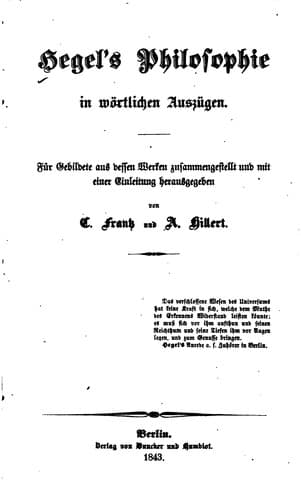
Hegel's Lectures on the History of Philosophy: Volume 3 (of 3)Hegel, Georg Wilhelm Friedrich
PhilosophyPhilosophy
Hegel's Lectures on the History of Philosophy: Volume 3 (of 3)
Hegel, Georg Wilhelm Friedrich
Philosophy -- History
Philosophy with the scholastics had consequently the same quality of
want of independence as it had before this with the Christian Fathers
and the Arabians. The Church as already constituted established itself
amongst the Teutonic nations, and through its constitution it conditioned
philosophy. The Christian Church had indeed spread itself abroad
throughout the Roman world, but, more especially in the beginning, it
merely formed a community of its own, by whom the world was renounced,
and which made no special claims to recognition—or if such claims were
made they were merely negative, because the individuals in the world
were simply martyrs, thus renouncing the world. But the Church in time
became dominant, and the Roman emperors, both of the East and of the
West, embraced Christianity. Thus the Church attained to a position
openly recognized and undisturbed, from which it exercised much influence
upon the world. The political world, however, fell into the hands of
the Teutonic nations, and thereby a new form arose, and to this the
scholastic philosophy pertains. We know the revolution by the name of the
Migration of the Nations (_supra_, pp. 23, 24). Fresh races inundated
the ancient Roman world and established themselves therein; they thus
erected their new world on the ruins of the old—a picture which Rome in
its present aspect still presents. There the splendour of the Christian
temples is due in part to the remnants of the ancient, and new palaces
are built on ruins and have ruins all around.
Public-domain text, read in full here on John Shaqi.
Reviews
Reviews
No reviews yet
Be the first to share your thoughts on this work.
Join the Discussion
Join the discussion
Sign in to leave a comment or review.
Sign InorCreate an account