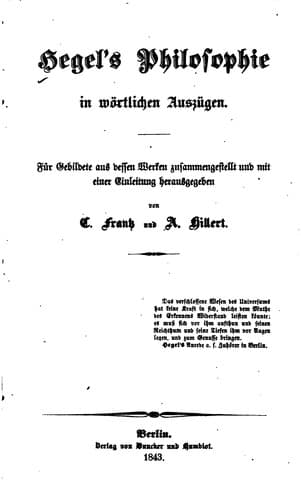
Hegel's Lectures on the History of Philosophy: Volume 3 (of 3)Hegel, Georg Wilhelm Friedrich
PhilosophyPhilosophy
Hegel's Lectures on the History of Philosophy: Volume 3 (of 3)
Hegel, Georg Wilhelm Friedrich
Philosophy -- History
Thus man reaches this truth, because for him it becomes a sure intuition
that in Christ the λόγος has become Flesh. We thus first have man
through this process attaining to spirituality, and in the second place
we have man as Christ, in whom this original identity of both natures
is known. Now since man really is this process of being the negation of
the immediate, and from this negation attaining to himself—to a unity
with God—he must consequently renounce his natural will, knowledge,
and existence. This giving up of his natural existence is witnessed in
Christ’s sufferings and death, and in His resurrection and elevation to
the right hand of the Father. Christ became a perfect man, endured the
lot of all men, death; as man He suffered, sacrificed Himself, gave up
His natural existence, and thereby elevated Himself above it. In Him
this process, this conversion of His other-being into spirit, and the
necessity of pain in the renunciation of the natural man is witnessed;
but this pain, the pain of feeling that God Himself is dead, is the
starting point of holiness and of elevation to God. Thus what must come
to pass in the subject—this process, this conversion of the finite—is
known as implicitly accomplished in Christ. This constitutes the great
leading Idea of Christianity.
From what has been said it follows, in the second place, that the world
must not be left in its immediate naturalness. The original, implicitly
existent, is found only in the strictest conception of mind, or as its
determination: immediately, man is only a living being, who has indeed
the capacity to become actual spirit—but spirit does not pertain to
nature. Man is thus not by nature this particular in which the spirit
of God lives and dwells: man is not by nature what he ought to be. The
animal is by nature what it ought to be. But what has to be noticed in
this respect is that natural things merely remain in their implicit
Notion, or their truth does not enter into their sensuous life, for this
their natural individuality is only a fleeting fact that cannot look back
on itself. The misfortune in natural things is that they get no further,
that their essential nature is not for itself and independent; from this
it follows that they do not attain to infinitude, to liberation from
their immediate individuality, _i.e._ they do not attain to freedom, but
only remain in the necessity which is the connection of the “one” with an
“other,” so that when this other unites itself to natural things, these
last perish because they cannot bear the contradiction. But because the
truth exists for man as consciousness, and in it he has the qualities
necessary for freedom, he is capable of perceiving the Absolute, of
placing himself in a relation to the same, and having knowledge as an
end; and the liberation of mind depends on the fact that consciousness
does not remain in its natural condition, but becomes spiritual, _i.e._
Public-domain text, read in full here on John Shaqi.
Reviews
Reviews
No reviews yet
Be the first to share your thoughts on this work.
Join the Discussion
Join the discussion
Sign in to leave a comment or review.
Sign InorCreate an account