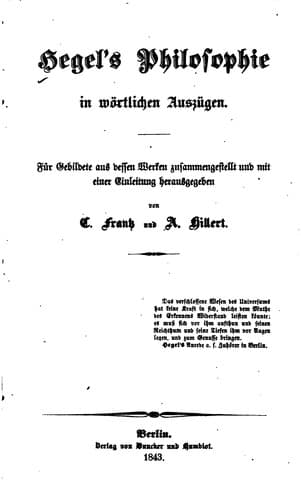
Hegel's Lectures on the History of Philosophy: Volume 3 (of 3)Hegel, Georg Wilhelm Friedrich
PhilosophyPhilosophy
Hegel's Lectures on the History of Philosophy: Volume 3 (of 3)
Hegel, Georg Wilhelm Friedrich
Philosophy -- History
that for it the eternal, that is the reconciliation of the finite as this
subject with the infinite, exists. Thus consciousness does not signify
remaining in the sphere of nature, but the existence of the process
whereby the universal becomes object or end to man. Man makes himself
divine, but in a spiritual, that is to say not in an immediate way. In
the ancient religions the divine is also united to the natural or human;
but this unity is no reconciliation, but an immediate, undeveloped, and
thus unspiritual unity, just because it is merely natural. But because
mind is not natural but only that into which it makes itself, the
spiritual is first met with in this very process of producing unity. To
this spiritual unity pertains the negation of nature, of the flesh, as
that in which man must not rest; for nature is from the beginning evil.
Man is likewise naturally evil, for all the wickedness that man does
proceeds from a natural desire. Now because man is in himself the image
of God, but in existence is only natural, that which is implicit must be
evolved, while the first natural condition must be abrogated. So much the
more is it true that man first becomes spiritual, and attains to truth
through rising above the natural, inasmuch as God Himself is a spirit
only in that He transformed the hidden unity into the other of Himself,
in order from this other to turn back again into Himself.
Now the fact that this is given as, or asserted to be the fundamental
Idea of Christianity, implies on the one hand an historic question;
at different times this idea has been grasped in different ways, and
now, for example, men again have their particular conceptions of it. In
order to bring about the conclusion that this is the historic idea of
Christianity, we should have to enter upon an historic disquisition;
but because we cannot deal with this here, we must accept it as an
historic axiom. On the other hand, in so far as this question falls
within the history of Philosophy, the assertion that this is the idea
of Christianity has another ground to stand on than that of history,
and this constitutes the third point of interest. In connection with
the preceding forms it has been shown that this Idea of Christianity
must have now come forth, and indeed become the universal consciousness
of the nations. The fact that it has come forth as the world-religion,
is the content of history; it is this necessity in the Idea which has
to be expounded more clearly in the philosophy of history. To this end
the conception of mind must be made fundamental, and it must now be
shown that history is the process of mind itself, the revelation of
itself from its first superficial, enshrouded consciousness, and the
attainment of this standpoint of its free self-consciousness, in order
that the absolute command of mind, “Know thyself,” may be fulfilled. The
recognition of this necessity has been called the _à priori_ construction
Public-domain text, read in full here on John Shaqi.
Reviews
Reviews
No reviews yet
Be the first to share your thoughts on this work.
Join the Discussion
Join the discussion
Sign in to leave a comment or review.
Sign InorCreate an account