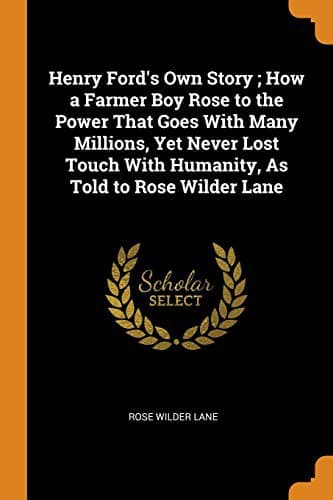
Henry Ford's Own Story: How a Farmer Boy Rose to the Power that goes with Many Millions, Yet Never Lost Touch with HumanityLane, Rose Wilder
Philosophy
Henry Ford's Own Story: How a Farmer Boy Rose to the Power that goes with Many Millions, Yet Never Lost Touch with Humanity
Lane, Rose Wilder
Automobile industry and trade -- United States -- History; Businesspeople -- United States -- Biography; Ford, Henry, 1863-1947
Ford was now a man of nearly 30, an insignificant, unimportant unit in
the business world of Detroit, merely one of the subordinate managers in
the Edison plant. Seeing him on his way home from work, a slender,
stooping, poorly dressed man, the firm set of his lips hidden by the
sandy mustache he wore then, and his blue eyes already surrounded by a
network of tired wrinkles, men probably looked at him half-pityingly,
and said: "There's a man who will never get anywhere."
He had his farm, unprofitable since he had left it, a small home partly
paid for, and the little gas engine, to show for fourteen years of hard
work.
Probably he received more than one letter from his father and brothers
in Greenfield, urging him to come back to the farm, where he and his
wife might live comfortably among their old friends, and he need not
work so hard. It would have seemed a wise move.
But with the completion of the little one-cylinder, high-speed engine,
Ford was more than ever possessed by his idea. He brought one or two of
the men from the Edison shop to see it. They watched it whirring away on
its pedestal of blocks, they examined its large cylinder, its
short-stroke piston, noted its power, and looked at Ford with some
increased respect. But most of them were nevertheless doubtful of the
success of the automobile. The idea of a horseless carriage in general
use still seemed to them fantastic.
"Well, looks like you could make it go," they conceded. "But it's going
to be pretty expensive to run. Not many people'll want to buy it. And
where will you get the capital to manufacture it?"
"I'm making it cheap. I'm going to make it cheap enough so every man in
this country can have one before I'm through," Ford said.
Already his belief that "a thing isn't any good unless it's good for
everybody" was taking form. He did not intend to make a few high-priced
toys for wealthy men; he planned to make something useful for thousands
of men like himself, who were wasting money in keeping idle horses, as
he had done on the farm. He still meant to make a farm tractor, as soon
as he had worked out the principle of a self-propelling machine.
As to the capital, he believed that question would take care of itself
when the time came. His job was to make the machine, and he did not
waste time telling himself that there was no chance for a poor man.
The problem of transmitting the power of the engine to the wheels now
engrossed his attention. He brought home materials for a light buggy
frame and built it. Four old bicycle wheels were repaired, fitted with
heavy rims and large pneumatic tires, and placed on the axles. The
question then was how to attach the engine.
To us, familiar with automobiles, it seems simple enough, but when Ford
stood in the old shed, looking at the buggy frame and then at the little
engine, he was attempting a feat that had never been accomplished.
Public-domain text, read in full here on John Shaqi.
Reviews
Reviews
No reviews yet
Be the first to share your thoughts on this work.
Join the Discussion
Join the discussion
Sign in to leave a comment or review.
Sign InorCreate an account