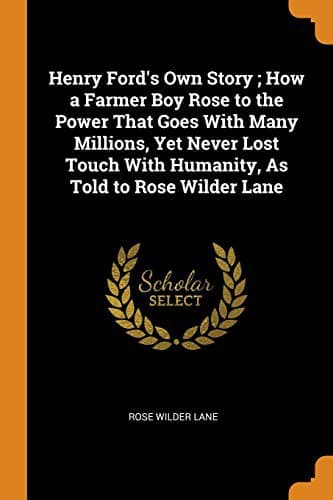
Henry Ford's Own Story: How a Farmer Boy Rose to the Power that goes with Many Millions, Yet Never Lost Touch with HumanityLane, Rose Wilder
Philosophy
Henry Ford's Own Story: How a Farmer Boy Rose to the Power that goes with Many Millions, Yet Never Lost Touch with Humanity
Lane, Rose Wilder
Automobile industry and trade -- United States -- History; Businesspeople -- United States -- Biography; Ford, Henry, 1863-1947
Always before, carriages had been pulled. Naturally enough his first
thought was to apply the power of the engine to the front wheels. Then
how should he steer? What mechanism should he use, powerful enough to
turn the hind wheels, against the pull of the engine, and flexible
enough to respond quickly and make a sharp turn?
Then there was the problem of the throttle, and the gears. The machine
must be able to go more slowly, or to pick up speed again, without
shutting off the power. The driver must be able, when necessary, to
throw off the power entirely, and to apply it quickly again, without
stopping the engine.
All these vexing questions, and many minor ones, were to be solved, and
always there was the big question of simplicity. The machine must be
cheap.
"I'm building this thing so it will be useful," Ford said once while he
was in the thick of his perplexities. "There isn't any object in working
at it unless it will be useful, and it won't be useful unless it's cheap
enough so common people can have it, and do their work with it."
The essential democracy of the man spoke then. It is the distinctly
American viewpoint of the man who for years had fought sun and wind and
weather, tearing his food and shelter from the stubborn grasp of the
soil, and who now struggles with mechanical obstacles, determined in
spite of them to make something for practical use. His standards of
value were not beauty or ease of luxury. He wanted to make a machine
that would do the greatest possible quantity of good, hard work.
His third winter in the house on Edison avenue arrived, and still the
automobile was not completed. When he went out to work in the old shed
after supper he lighted a fire in the rusty heating stove, set up in a
corner, and often Mrs. Ford came out and sat on a box, watching while he
fitted parts together or tried different transmission devices.
He had settled finally on a leather belt, passing over the flywheel and
connecting with the rear axle. A pulley arrangement, controlled by a
lever, tightened or loosened this belt, thus increasing or decreasing
the speed of the automobile. That broad strip of leather, inclosed,
running from the engine on the rear axle to the pulley under the front
seat, was the parent of the planetary system of transmission.
Ford worked on it all winter. It was a lonely time for Mrs. Ford, for
the general attitude of the neighborhood toward her husband had roused
her good country temper, and she "refused to have anything to do with
people who talked like that." She knew Henry was perfectly sane, a
better husband than most of them had, too, and anyhow it was none of
their business how Henry spent his time, and if they didn't like, they
could lump it.
Public-domain text, read in full here on John Shaqi.
Reviews
Reviews
No reviews yet
Be the first to share your thoughts on this work.
Join the Discussion
Join the discussion
Sign in to leave a comment or review.
Sign InorCreate an account