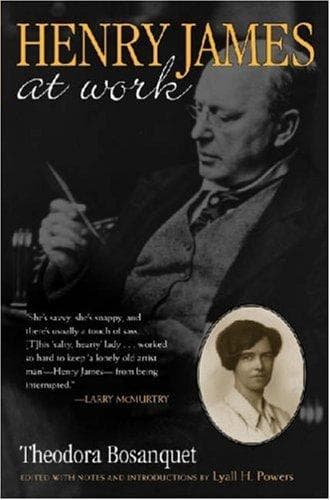
Authors, American -- 19th century -- Biography; James, Henry, 1843-1916
Friendships are maintained by the communication of speech and letters.
Henry James was a voluminous letter-writer and exhaustively
communicative in his talk upon every subject but one, his own work,
which was his own real life. It was not because he was indifferent to
what people thought of his books that he evaded discussion about them.
He was always touched and pleased by any evidence that he had been
intelligently read, but he never went a step out of his way to seek this
assurance. He found it safest to assume that nobody read him, and he
liked his friends none the worse for their incapacity. Meanwhile, the
volumes of his published works--visible, palpable, readable proof of
that unceasing travail of the creative spirit which was always labouring
behind the barrier of his silence--piled themselves up year after year,
to be dropped on to the tables of booksellers and pushed on to the
shelves of libraries, to be bought and cherished by the faithful,
ignored by the multitude, and treated as a test of mental endurance by
the kind of person who organized the Browning Society. Fortunately for
literature, Henry James did not lend himself to exploitation by any
Jacobean Society. Instead of inventing riddles for prize students, he
scattered about his pages a number of pregnant passages containing all
the clues that are needed for keeping up with him. It was his theory
that if readers didn't keep up with him--as they admittedly didn't
always--the fault was entirely in their failure of attention. There are
revelations in his books, just as he declared them to be in the works of
Neil Paraday. "Extract the opinion, disengage the answer--these are the
real acts of homage."
VIII
Public-domain text, read in full here on John Shaqi.
Reviews
Reviews
No reviews yet
Be the first to share your thoughts on this work.
Join the Discussion
Join the discussion
Sign in to leave a comment or review.
Sign InorCreate an account