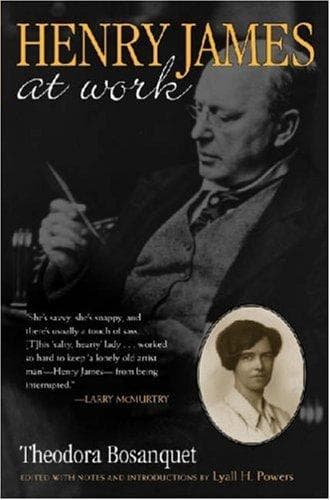
Authors, American -- 19th century -- Biography; James, Henry, 1843-1916
From his familiar correspondence we need not hope to extract as
considered an opinion or as definite an answer as from the novels, but
his letters are extraordinarily valuable as sidelights, helping us to
see how it happened that any man was able to progress along so straight
a path from one end of his life to another. The two Volumes of memories
are clear evidence of the kind of temperamental make-up with which Henry
James was gifted, the two volumes of letters show how his life
contributed to preserve and enhance his rare capacity for taking and
keeping impressions. They show him too as unusually impervious to
everything which is not an impression of visual images or a sense of a
human situation. He was very little troubled by a number of ideas which
press with an increasing weight upon the minds of most educated persons.
Not until the outbreak of the Great War was he moved to utter a forcible
"opinion" about affairs outside his personal range. He was delightfully
free from the common delusion that by grouping individuals in arbitrary
classes and by twisting harmless adjectives into abstract nouns it is
possible for us to think of more than one thing at a time and to
conceive of qualities apart from their manifestation. What he saw he
possessed; what he understood he criticized, but he never reckoned it to
be any part of his business to sit in judgment on the deeds of men
working in alien material for inartistic ends, or to speculate about the
nature of the universe or the conflict or reconciliation of science with
religion. He could let Huxley and Gladstone, the combatant champions of
Darwinism and orthodox theology, enrich the pages of a single letter
without any reference to their respective beliefs. "Huxley is a very
genial, comfortable being . . . But of course my talk with him is mere
amiable generalities." Of Gladstone there is a little more, but again
the personal impression is the thing sought. "I was glad of a chance to
feel the 'personality' of a great political leader--or as G. is now
thought here even, I think, by his partisans, ex-leader. That of
Gladstone is very fascinating--his urbanity extreme--his eye that of a
man of genius--and his apparent self-surrender to what he is talking of
without a flaw. He made a great impression on me." One would like to
know what the subject was to which Gladstone had surrendered himself in
his talk with this entranced young American, who must surely, for his
part, have been as much reduced conversationally to "mere amiable
generalities" as on the occasion of his meeting Huxley. It is difficult
to think of a single likely point of contact between the minds of
Gladstone and Henry James. But that, for delicacy of registration, was
an advantage. The recording instrument could perform its work without
the hindrance of any distraction of attention from the man himself to
the matter of his speech, which did not presumably contain any germ for
cultivation into fiction.
Public-domain text, read in full here on John Shaqi.
Reviews
Reviews
No reviews yet
Be the first to share your thoughts on this work.
Join the Discussion
Join the discussion
Sign in to leave a comment or review.
Sign InorCreate an account