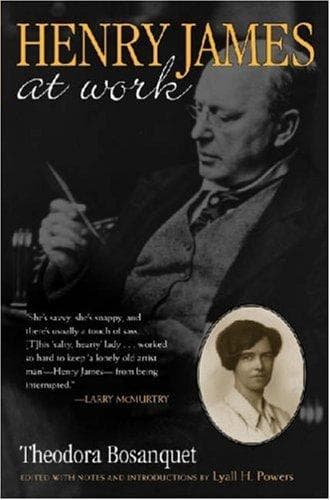
Authors, American -- 19th century -- Biography; James, Henry, 1843-1916
By that time Henry James was at his ease in England. The inhabitants
were no longer either gods or imbeciles. Through the general British fog
he had perceived gleams of intelligence shining on his bewilderment. He
was no longer wholly dependent on Boston for refreshment. He could fall
back upon the company of Mr. Edmund Gosse and he had found a friend in
R. L. Stevenson. The little handful of Islanders possessed of a genuine
interest in the art of letters and the criticism of life emerged from
the obscurity, and he made out that, on the whole, there were perhaps
about as many civilized people in England as in his native land. Yet he
was a little troubled about his position. He wondered, while he reviewed
the past, whether the path he had so carefully chosen for himself was
the right one, whether he might not have missed more by leaving the
United States than he had gained by coming to England. He lamented; in a
letter written to his brother William in 1899, that he had not had the
kind of early experience that might have attached him to his own
country. He earnestly advised a different treatment for his nephews.
"What I most of all feel, and in the light of it conjure you to keep
doing for them, is their being _à même_ to contract local saturations
and attachments in respect to their _own_ great and glorious country, to
learn, and strike roots into, its infinite beauty, as I suppose, and
variety. . . . Its being their 'own' will double their _use_ of it."
It was only after a visit to America in 1904 that he found, on his
return to Rye, that he had a home and a country. He was able after this
discovery to write to Mrs. Wharton that "your only drawback is not
having the homeliness and the inevitability and the happy limitation and
the affluent poverty, of a Country of your Own (comme moi, par
exemple!)"; and he could declare after taking the Oath of Allegiance to
the King of England in 1915 that "I was really too associated before for
any nominal change to matter. The process has only shown me what I
virtually _was_--so that it's rather disappointing in respect to acute
sensation. I _haven't_ any." Associated he certainly was, allied by
innumerable sympathies and affections to the adopted country. But he was
never really English or American or even Cosmopolitan, And it is too
difficult to suppose that even if he had passed all his youth in New
England and contracted all the local saturations and attachments he
urged for his nephews he could ever have melted comfortably into
American uniformity. He, who took nothing in the world for granted,
could surely never have taken New England for granted.
Public-domain text, read in full here on John Shaqi.
Reviews
Reviews
No reviews yet
Be the first to share your thoughts on this work.
Join the Discussion
Join the discussion
Sign in to leave a comment or review.
Sign InorCreate an account