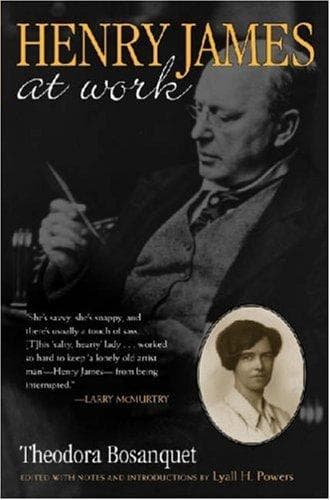
Authors, American -- 19th century -- Biography; James, Henry, 1843-1916
To-day, with the complete record before us--the novels, criticisms,
biographies, plays, and letters--we can understand how little those
international relations that engaged Henry James's attention mattered to
his genius. Wherever he might have lived and whatever human interactions
he might have observed, he would in all probability have reached much
the same conclusion that he arrived at by the way of America, France,
and England. When he walked out of the refuge of his study into the
world and looked about him, he saw a place of torment, where creatures
of prey perpetually thrust their claws into the quivering flesh of the
doomed, defenceless children of light. He had the abiding comfort of an
inner certainty (and perhaps he did bring that from New England) that
the children of light had an eternal advantage; he was aware to the
finest fibre of his being that the "poor sensitive gentlemen" he so
numerously treated possessed a treasure that would outlast all the
glittering paste of the world and the flesh; he knew that nothing in
life mattered compared with spiritual decency.
We may conclude that the nationalities of his betrayed and triumphant
victims are not an important factor. They may equally well be innocent
Americans maltreated by odious Europeans, refined Europeans fleeced by
unscrupulous Americans, or young children of any race exposed to evil
influences. The essential fact is that wherever he looked Henry James
saw fineness apparently sacrificed to grossness, beauty to avarice,
truth to a bold front. He realized how constantly the tenderness of
growing life is at the mercy of personal tyranny and he hated the
tyranny of persons over each other. His novels are a repeated exposure
of this wickedness, a reiterated and passionate plea for the fullest
freedom of development, unimperilled by reckless and barbarous
stupidity.
He was himself most scrupulously careful not to exercise any tyrannical
power over other people. The only advice he ever permitted himself to
offer to a friend was a recommendation to "let your soul live." Towards
the end of his days his horror of interfering, or seeming to interfere,
with the freedom of others became so overpowering that it was a misery
for him to suspect that the plans of his friends might be made with
reference to himself. Much as he enjoyed seeing them, he so disliked to
think that they were undergoing the discomfort of voyages and railway
journeys in order to be near him that he would gladly have prevented
their start if he could. His Utopia was an anarchy where nobody would be
responsible for any other human being but only for his own civilized
character. His circle of friends will easily recall how finely Henry
James had fitted himself to be a citizen of this commonwealth.
End of Project Gutenberg's Henry James at Work, by Theodora Bosanquet
Public-domain text, read in full here on John Shaqi.
Reviews
Reviews
No reviews yet
Be the first to share your thoughts on this work.
Join the Discussion
Join the discussion
Sign in to leave a comment or review.
Sign InorCreate an account