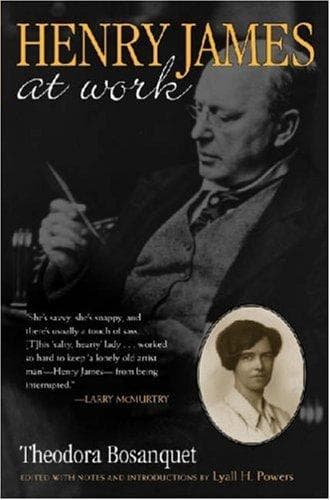
Authors, American -- 19th century -- Biography; James, Henry, 1843-1916
If the interview was overwhelming, it had none of the usual awkwardness
of such curious conversations. Instead of critical angles and
disconcerting silences, there were only benign curves and ample
reassurances. There was encouraging gaiety in an expanse of bright check
waistcoat. He invited me to ask any questions I liked, but I had none to
ask. I wanted nothing but to be allowed to go to Rye and work his
typewriter. He was prepared, however, with his statements and, once I
was seated opposite to him, the strong, slow stream of his deliberate
speech played over me without ceasing. He had it on his mind to tell me
the conditions of life and labour at Rye, and he unburdened himself
fully, with numberless amplifications and qualifications but without any
real break. It would be a dull business, he warned me, and I should
probably find Rye a dull place. He told me of rooms in Mermaid Street,
"very simple, rustic and antique--but that is the case for everything
near my house, and this particular little old house is very near mine,
and I know the good woman for kind and worthy and a convenient cook and
in short----." It was settled at once that I should take the rooms, that
I should begin my duties in October.
II
Since winter was approaching, Henry James had begun to use a panelled,
green-painted room on the upper floor of Lamb House for his work. It was
known simply as the green room. It had many advantages as a winter
workroom, for it was small enough to be easily warmed and a wide south
window caught all the morning sunshine. The window overhung the smooth,
green lawn, shaded in summer by a mulberry tree, surrounded by roses and
enclosed behind a tall, bride wall. It never failed to give the owner
pleasure to look out of this window at his charming English garden where
he could watch his English gardener digging the flower-beds or mowing
the lawn or sweeping up fallen leaves. There was another window for the
afternoon sun, looking towards Winchelsea and doubly glazed against the
force of the westerly gales. Three high bookcases, two big writing-desks
and an easy chair filled most of the space in the green room, but left
enough dear floor for a restricted amount of the pacing exercise that
was indispensable to literary composition. On summer days Henry James
liked better to work in the large "garden room" which gave him a longer
stretch for perambulation and a window overlooking the cobbled street
that curved up the hill past his door. He liked to be able to relieve
the tension of a difficult sentence by a glance down the street; he
enjoyed hailing a passing friend or watching a motor-car pant up the
sharp little slope. The sight of one of these vehicles could be counted
on to draw from him a vigorous outburst of amazement, admiration, or
horror for the complications of an age that produced such efficient
monsters for gobbling protective distance.
Public-domain text, read in full here on John Shaqi.
Reviews
Reviews
No reviews yet
Be the first to share your thoughts on this work.
Join the Discussion
Join the discussion
Sign in to leave a comment or review.
Sign InorCreate an account