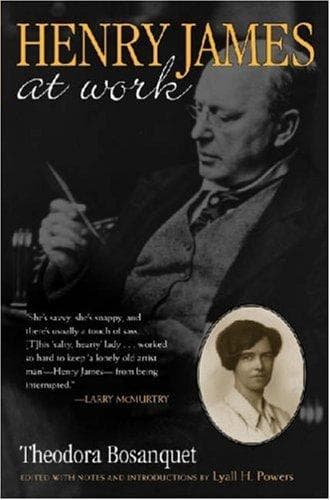
Authors, American -- 19th century -- Biography; James, Henry, 1843-1916
The business of acting as a medium between the spoken and the
typewritten word was at first as alarming as it was fascinating. The
most handsome and expensive typewriters exercise as vicious an influence
as any others over the spelling of the operator, and the new pattern of
a Remington machine which I found installed offered a few additional
problems. But Henry James's patience during my struggles with that
baffling mechanism was unfailing--he watched me helplessly, for he was
one of the few men without the smallest pretension to the understanding
of a machine--and he was as easy to spell from as an open dictionary.
The experience of years had evidently taught him that it was not safe to
leave any word of more than one syllable to luck. He took pains to
pronounce every pronounceable letter, he always spelt out words which
the ear might confuse with others, and he never left a single,
punctuation mark unuttered, except sometimes that necessary point, the
full stop. Occasionally, in a low "aside" he would interject a few words
for the enlightenment of the amanuensis, adding, for instance, after
spelling out "The Newcomes," that the words were the title of a novel by
one Thackeray.
The practice of dictation was begun in the nineties. By 1907 it was a
confirmed habit, its effects being easily recognizable in his style,
which became more and more like free, involved, unanswered talk. "I
know," he once said to me, "that I'm too diffuse when I'm dictating."
But he found dictation not only an easier but a more inspiring method of
composing than writing with his own hand, and he considered that the
gain in expression more than compensated for any loss of concision. The
spelling out of the words, the indication of commas, were scarcely felt
as a drag on the movement of his thought. "It all seems," he once
explained, "to be so much more effectively and unceasingly _pulled_ out
of me in speech than in writing." Indeed, at the time when I began to
work for him, he had reached a stage at which the click of a Remington
machine acted as a positive spur. He found it more difficult to compose
to the music of any other make. During a fortnight when the Remington
was out of order he dictated to an Oliver typewriter with evident
discomfort, and he found it almost impossibly disconcerting to speak to
something that made no responsive sound at all. Once or twice when he
was ill and in bed I took down a note or two by hand, but as a rule he
liked to have the typewriter moved into his bedroom for even the
shortest letters. Yet there were to the end certain kinds of work which
he was obliged to do with a pen. Plays, if they were to be kept within
the limits of possible performance, and short stories, if they were to
remain within the bounds of publication in a monthly magazine, must be
written by hand. He was well aware that the manual labour of writing was
his best aid to a desired brevity. The plays--such a play as _The
Public-domain text, read in full here on John Shaqi.
Reviews
Reviews
No reviews yet
Be the first to share your thoughts on this work.
Join the Discussion
Join the discussion
Sign in to leave a comment or review.
Sign InorCreate an account