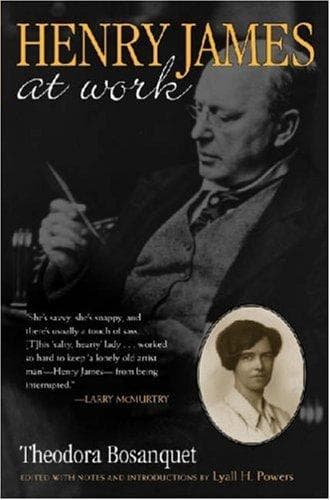
Authors, American -- 19th century -- Biography; James, Henry, 1843-1916
Outcry_, for instance--were copied straight from his manuscript, since
he was too much afraid of "the murderous limits of the English theatre"
to risk the temptation of dictation and embroidery. With the short
stories he allowed himself a little more freedom, dictating them from
his written draft and expanding them as he went to an extent which
inevitably defeated his original purpose. It is almost literally true to
say of the sheaf of tales collected in _The Finer Grain_ that they were
all written in response to a single request for a short story for
_Harper's Monthly Magazine._ The length was to be about 5,000 words and
each promising idea was cultivated in the optimistic belief that it
would produce a flower too frail and small to demand any exhaustive
treatment. But even under pressure of being written by hand, with
dictated interpolations rigidly restricted, each in turn pushed out to
lengths that no chopping could reduce to the word limit. The tale
eventually printed was _Crapy Cornelia_, but, although it was the
shortest of the batch, it was thought too long to be published in one
number and appeared in two sections, to the great annoyance of the
author.
III
The method adopted for full-length novels was very different. With a
clear run of 100,000 words or more before him, Henry James always
cherished the delusive expectation of being able to fit his theme quite
easily between the covers of a volume. It was not until he was more than
half way through that the problem of space began to be embarrassing. At
the beginning he had no questions of compression to attend to, and he
"broke ground," as he said, by talking to himself day by day about the
characters and construction until the persons and their actions were
vividly present to his inward eye. This soliloquy was of course recorded
on the typewriter. He had from far back tended to dramatize all the
material that life gave him, and he more and more prefigured his novels
as staged performances, arranged in acts and scenes, with the characters
making their observed entrances and exits. These scenes he worked out
until he felt himself so thoroughly possessed of the action that he
could begin on the dictation of the book itself--a process which has
been incorrectly described by one critic as re-dictation from a rough
draft. It was nothing of the kind. Owners of the volumes containing _The
Ivory Tower_ or _The Sense of the Past_ have only to turn to the Notes
printed at the end to see that the scenario dictated in advance contains
practically none of the phrases used in the final work. The two sets of
Notes are a different and a much more interesting literary record than a
mere draft. They are the framework set up for imagination to clothe with
the spun web of life. But they are not bare framework. They are
elaborate and abundant. They are the kind of exercise described in _The
Death of the Lion_ as "a great gossiping eloquent letter--the overflow
Public-domain text, read in full here on John Shaqi.
Reviews
Reviews
No reviews yet
Be the first to share your thoughts on this work.
Join the Discussion
Join the discussion
Sign in to leave a comment or review.
Sign InorCreate an account